
Contents
- 🎵 Origins & History
- ⚙️ How It Works
- 📊 Key Facts & Numbers
- 👥 Key People & Organizations
- 🌍 Cultural Impact & Influence
- ⚡ Current State & Latest Developments
- 🤔 Controversies & Debates
- 🔮 Future Outlook & Predictions
- 💡 Practical Applications
- 📚 Related Topics & Deeper Reading
- Frequently Asked Questions
- References
- Related Topics
Overview
The quest for safer and more environmentally benign refrigerants began long before the current climate crisis. Early refrigeration systems in the late 19th and early 20th centuries relied on toxic or flammable substances like ammonia (R-717), sulfur dioxide (R-764), and methyl chloride (R-40). The development of chlorofluorocarbons (CFCs) like R-12 and hydrochlorofluorocarbons (HCFCs) like R-22 in the mid-20th century offered non-toxic and non-flammable alternatives, quickly dominating the market. However, the discovery of their ozone-depleting potential led to the Montreal Protocol in 1987, mandating their phase-out. This spurred the development of hydrofluorocarbons (HFCs) like R-134a, which were ozone-friendly but later revealed to be potent greenhouse gases, prompting the current shift towards alternative refrigerants under the Kigali Amendment.
⚙️ How It Works
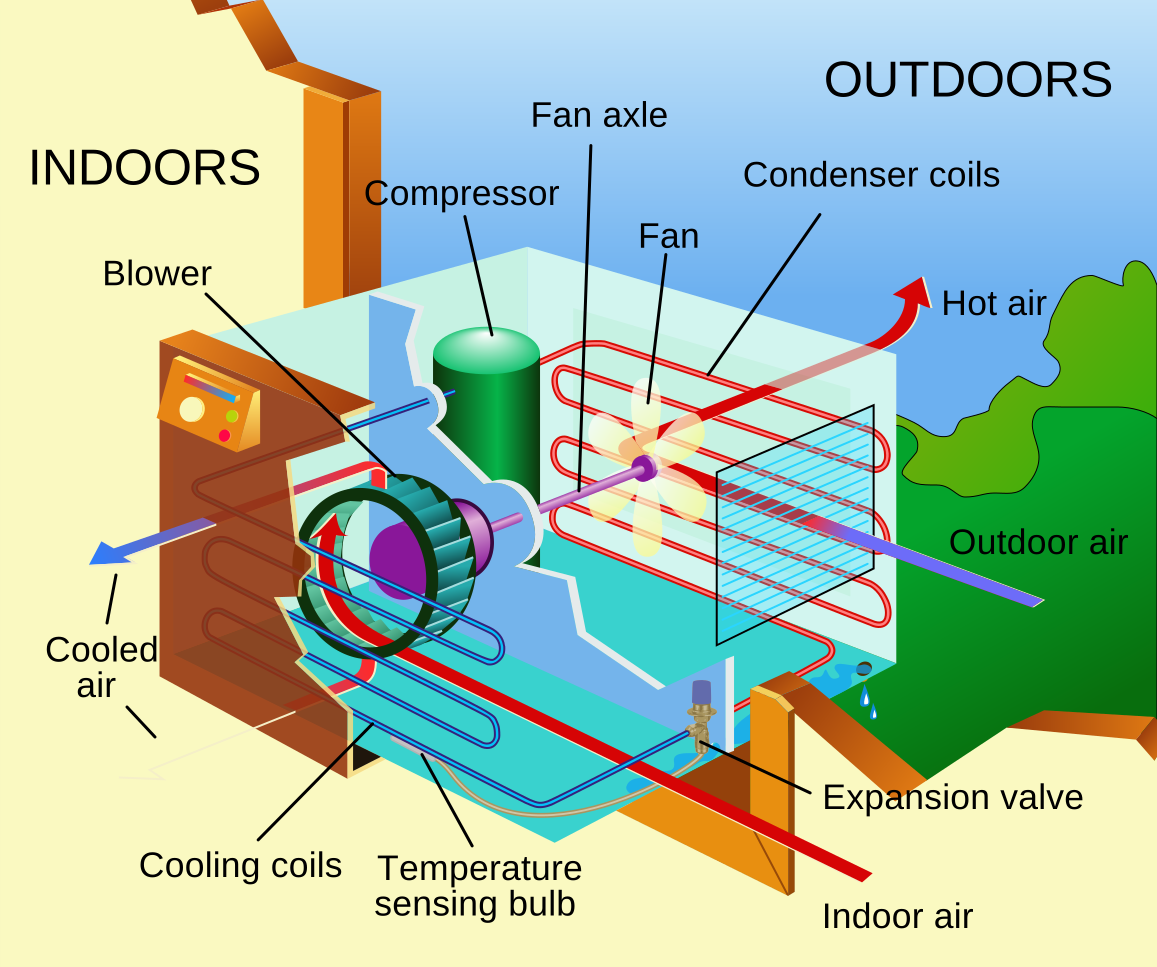
Alternative refrigerants function within the same thermodynamic principles as their predecessors, primarily in vapor-compression cycles. The core idea is to exploit phase changes (evaporation and condensation) to transfer heat. A refrigerant circulates through a closed loop, absorbing heat from a low-temperature space (e.g., inside a refrigerator or building), causing it to evaporate into a gas. This gas is then compressed, increasing its temperature and pressure. The hot, high-pressure gas then flows through a condenser, where it releases heat to a higher-temperature environment (e.g., the room or outdoors), condensing back into a liquid. This liquid then passes through an expansion valve, reducing its pressure and temperature, ready to repeat the cycle. The key difference with alternative refrigerants lies in their chemical composition, which dictates their thermodynamic properties, environmental impact (GWP and ODP), flammability, and toxicity.
📊 Key Facts & Numbers
The global refrigerant market is a colossal enterprise, projected to reach approximately $22.5 billion by 2027, according to some industry analyses. The phase-down of HFCs under the Kigali Amendment targets a reduction of 80-85% by 2047 compared to 2011-2013 levels, impacting billions of cooling units worldwide. Hydrofluoroolefins (HFOs), a leading class of alternatives, typically have GWPs below 10, a stark contrast to HFCs like R-410A, which has a GWP of around 2088. Natural refrigerants, such as ammonia (R-717), boast a GWP of 0 and an Ozone Depletion Potential (ODP) of 0, but their use is often limited by flammability or toxicity concerns. For instance, propane (R-290) has a GWP of just 3, but its flammability requires stringent safety measures, limiting its charge size in many applications. The transition involves an estimated 1.5 billion air conditioning units and 2 billion refrigerators globally that will eventually need to be serviced or replaced with systems using these new refrigerants.
👥 Key People & Organizations
The development and adoption of alternative refrigerants involve a diverse cast of characters. Chemical giants like DuPont (now Chemours) and Honeywell have been at the forefront of HFO development, investing billions in research and manufacturing. UNEP has been instrumental in coordinating the global phase-out of ozone-depleting substances and the subsequent HFC phase-down through the Montreal Protocol and its amendments. Organizations like the AHRI and the IIR play crucial roles in setting standards, conducting research, and facilitating industry dialogue. Innovators in natural refrigerants include companies like Bitzer and Danfoss, who are developing compressors and systems optimized for ammonia and hydrocarbons, while Google has explored using CO2 for data center cooling.
🌍 Cultural Impact & Influence
The cultural resonance of alternative refrigerants is deeply tied to the growing global awareness of climate change and environmental responsibility. What was once a purely technical concern for engineers and manufacturers has become a mainstream issue, influencing consumer choices and corporate sustainability goals. The shift away from potent greenhouse gases is a tangible manifestation of collective action towards a more sustainable future, often highlighted in corporate social responsibility reports and environmental documentaries. This transition also fosters a sense of innovation and progress, positioning companies that adopt these technologies as forward-thinking and environmentally conscious. The aesthetic of 'green' technology is increasingly valued, influencing product design and marketing strategies across the HVACR sector.
⚡ Current State & Latest Developments
The current landscape of alternative refrigerants is characterized by rapid innovation and market shifts. The Kigali Amendment is driving significant HFC phase-downs in major markets, with the United States implementing its own HFC phasedown under the AIM Act starting in 2022. This has led to increased demand for HFOs and a resurgence in interest for natural refrigerants. Manufacturers are actively redesigning equipment to accommodate refrigerants with different properties, such as lower boiling points or flammability. For example, Bosch and LG are incorporating lower-GWP refrigerants into their new appliance lines. The development of A2L refrigerants (mildly flammable) is a major trend, requiring new safety standards and training for technicians, as seen in the evolving guidelines from organizations like UL Solutions.
🤔 Controversies & Debates
The transition to alternative refrigerants is not without its controversies and debates. A primary concern revolves around the flammability of many promising alternatives, particularly hydrocarbons like propane (R-290) and isobutane (R-600a), and the mildly flammable A2L refrigerants like HFOs. This necessitates stricter safety regulations, increased training for HVACR technicians, and potentially higher installation costs, sparking debate about the pace and feasibility of widespread adoption, especially in densely populated areas or sensitive environments. Another point of contention is the cost and availability of new refrigerants and compatible equipment. While HFOs offer low GWP, they can be significantly more expensive than legacy HFCs. Furthermore, the long-term environmental impact and potential breakdown products of some HFOs are still under scrutiny by researchers at institutions like MIT.
🔮 Future Outlook & Predictions
The future of refrigerants points towards a diversified portfolio, rather than a single silver bullet. Expect continued growth in the adoption of HFOs and A2L refrigerants for mainstream applications like residential air conditioning and automotive cooling, driven by regulatory mandates and performance advantages. Natural refrigerants, particularly ammonia for industrial uses and propane and isobutane for smaller commercial and domestic appliances, will likely see increased market share due to their zero GWP. Research into novel refrigerant blends and even non-vapor-compression technologies, such as thermoelectric cooling or magnetic refrigeration, may gain traction for niche applications. The global refrigerant management infrastructure, including recovery, recycling, and destruction, will become increasingly critical to ensure the sustainability of this transition.
💡 Practical Applications
Alternative refrigerants are finding applications across a vast spectrum of cooling needs. In residential and light commercial air conditioning, HFO blends and propane (R-290) are becoming standard. Industrial refrigeration, from food processing plants to cold storage warehouses, is increasingly utilizing ammonia (R-717) due to its efficiency and zero GWP, despite its toxicity. The automotive sector is rapidly moving away from R-134a towards lower-GWP HFOs like R-1234yf. Even data centers are exploring alternatives, with CO2 (R-744) and advanced liquid cooling systems gaining attention to manage the immense heat loads generated by AI computing. Supermarket refrigeration systems are also transitioning to propane (R-290) and CO2 (R-744) for their display cases and walk-in coolers.
Key Facts
- Year
- 2020s
- Origin
- Global
- Category
- technology
- Type
- technology
Frequently Asked Questions
What are the main types of alternative refrigerants?
The main categories include hydrofluoroolefins (HFOs), which have very low global warming potential (GWP), and natural refrigerants. Natural refrigerants are substances that occur in nature and include CO2 (R-744), ammonia (R-717), and hydrocarbons like propane (R-290) and isobutane (R-600a). Many HFOs are also blended with other compounds to create A2L refrigerants, which are mildly flammable but offer significantly lower GWPs than traditional HFCs.
Why are we moving away from HFCs?
Hydrofluorocarbons (HFCs) were introduced as replacements for ozone-depleting substances but were later found to be potent greenhouse gases. Their high global warming potential (GWP) contributes significantly to climate change. International agreements, most notably the Kigali Amendment, mandate a global phase-down of HFC production and consumption to mitigate their climate impact, aiming for an 80-85% reduction by 2047.
What are the challenges in adopting alternative refrigerants?
The primary challenges include the flammability of many alternatives, requiring new safety standards and technician training. Some alternatives, like HFOs, can be more expensive than legacy HFCs, impacting equipment costs. Additionally, different refrigerants have varying thermodynamic properties, necessitating redesigns of existing refrigeration and air conditioning systems for optimal efficiency and performance. Ensuring a robust supply chain for these new refrigerants is also a critical factor.
Are natural refrigerants safe to use?
Natural refrigerants like ammonia (R-717) are non-flammable but toxic, requiring strict safety protocols and specialized handling, making them ideal for industrial applications where trained personnel are present. Hydrocarbons like propane (R-290) and isobutane (R-600a) are highly flammable, limiting their use to smaller charge sizes in domestic and light commercial equipment, governed by specific safety standards like IEC 60335-2-89. CO2 (R-744) operates at very high pressures, requiring robust system components.
How do alternative refrigerants affect energy efficiency?
The impact on energy efficiency varies. Some alternative refrigerants, like ammonia (R-717) in industrial settings, can offer higher energy efficiency than older HFCs. Hydrocarbons like propane (R-290) also demonstrate good efficiency in domestic refrigerators and freezers. HFOs and their blends are designed to match or exceed the efficiency of the HFCs they replace, though system optimization is crucial. The goal is to achieve environmental benefits without compromising, and ideally improving, energy performance.
What is the role of regulations in the refrigerant transition?
Regulations are the primary driver for the shift to alternative refrigerants. International agreements like the Kigali Amendment set global targets for HFC phase-downs. National regulations, such as the AIM Act in the U.S. and similar legislation in the European Union, implement these targets through specific rules on production, import, and use of refrigerants. These regulations create market certainty and incentivize the development and adoption of lower-GWP alternatives.
What does the future hold for refrigerant technology?
The future likely involves a diverse mix of refrigerants tailored to specific applications. We'll see continued innovation in HFO blends and A2L refrigerants for mainstream cooling. Natural refrigerants will expand their market share, especially in industrial and commercial sectors. Research into entirely new cooling technologies, such as magnetic refrigeration or advanced solid-state cooling, may also emerge for specialized uses. Furthermore, enhanced refrigerant management, including recovery, recycling, and destruction, will be critical for sustainability.