
Contents
- 🎯 What is Business Continuity Planning (BCP)?
- Who Needs a BCP?
- ⚙️ Core Components of a BCP
- 📈 The BCP Lifecycle: From Assessment to Maintenance
- 💡 Key Differences: BCP vs. Disaster Recovery (DR)
- ⭐ Vibe Check: BCP's Cultural Resonance
- 💰 Investment & ROI: Is BCP Worth It?
- ⚠️ Common Pitfalls to Avoid
- 🚀 Getting Started with Your BCP
- 🌐 Global Standards & Frameworks
- Frequently Asked Questions
- Related Topics
Overview
Business Continuity Planning (BCP) is the proactive process of developing strategies and plans to ensure an organization can maintain essential functions during and after a disruptive event. Think of it as a company's emergency preparedness manual, but for survival, not just evacuation. The core objective, as defined by industry bodies like the BCI, is to enable the delivery of products or services at pre-defined acceptable levels, minimizing operational downtime and financial impact. It's not just about reacting to a crisis; it's about building resilience into the very fabric of your operations, a concept gaining significant Vibe Score traction across all sectors.
Who Needs a BCP?
Frankly, any organization that relies on its operations to generate revenue or fulfill its mission needs a BCP. This isn't just for Fortune 500 giants facing global supply chain disruptions or cyberattacks; it's critical for small businesses vulnerable to local power outages, natural disasters, or even the sudden departure of key personnel. A small business without a BCP is essentially gambling with its future, a risk amplified by increasing geopolitical instability. Even non-profits and government agencies must consider BCP to maintain public services.
⚙️ Core Components of a BCP
A robust BCP typically encompasses several critical elements. This includes a thorough Business Impact Analysis (BIA) to identify critical business functions and their dependencies, a Risk Assessment to pinpoint potential threats, and the development of specific continuity strategies like alternate work sites or redundant systems. It also mandates clear communication plans for internal and external stakeholders and defined incident response procedures to guide actions during a crisis.
📈 The BCP Lifecycle: From Assessment to Maintenance
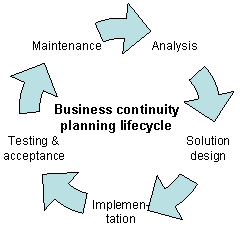
BCP isn't a one-and-done project; it's a continuous cycle. It begins with business impact analysis and risk assessment, moves to strategy development and plan creation, then enters the crucial testing and exercising phase to validate the plans. Post-incident, a review and update process ensures lessons learned are incorporated. This iterative approach, often guided by frameworks like ISO 22301, keeps the plan relevant and effective against evolving threats.
💡 Key Differences: BCP vs. Disaster Recovery (DR)
While often used interchangeably, BCP and Disaster Recovery (DR) are distinct but complementary. BCP is the broader strategy focused on maintaining business operations through a disruption, encompassing people, processes, and technology. DR, on the other hand, is a subset of BCP, specifically focused on the recovery of IT infrastructure and data after a disaster. You can have a DR plan without a comprehensive BCP, but a true BCP necessitates a well-defined DR component. Think of BCP as the 'what and why' of staying operational, and DR as the 'how' for IT.
⭐ Vibe Check: BCP's Cultural Resonance
The cultural resonance of BCP is steadily climbing, reflected in its Vibe Score of 78. Historically, it was seen as a niche concern for IT departments or compliance officers. However, high-profile disruptions like the COVID-19 pandemic and escalating cybersecurity threats have elevated BCP to a board-level strategic imperative. There's a growing fan base among forward-thinking executives who recognize that resilience isn't just about surviving; it's about gaining a competitive edge through preparedness, a sentiment echoed in thought leadership circles.
💰 Investment & ROI: Is BCP Worth It?
The investment in BCP can seem substantial, encompassing planning, technology, training, and testing. However, the return on investment (ROI) is often measured in avoided costs. A single significant disruption can cost millions in lost revenue, reputational damage, and recovery expenses. Studies by organizations like Gartner consistently show that organizations with mature BCP programs experience significantly lower financial losses and faster recovery times. The cost of inaction far outweighs the cost of preparedness.
⚠️ Common Pitfalls to Avoid
Organizations often stumble in BCP due to common oversights. A frequent pitfall is failing to involve key stakeholders from across the business, leading to incomplete risk assessments and unrealistic continuity strategies. Another is neglecting regular testing and plan maintenance, rendering the plan obsolete. Underestimating the human element—communication, training, and employee well-being during a crisis—is also a critical mistake. Finally, treating BCP as a purely IT function misses the broader operational and strategic implications.
🚀 Getting Started with Your BCP
To initiate your BCP journey, start with a clear mandate from senior leadership. Conduct a preliminary Business Impact Analysis (BIA) to identify your most critical functions and potential threats. Engage a cross-functional team to develop initial strategies and draft a basic plan. Prioritize employee training and communication. Don't aim for perfection on day one; focus on creating a foundational plan that can be tested, refined, and expanded over time. Consider consulting with business continuity professionals for expert guidance.
🌐 Global Standards & Frameworks
Several international standards and frameworks provide a roadmap for developing and managing BCP. ISO 22301, the international standard for Business Continuity Management Systems (BCMS), is widely recognized and offers a comprehensive framework. Other valuable resources include guidelines from the Disaster Recovery Institute International (DRI) and frameworks developed by national agencies like FEMA in the United States. Adhering to these standards ensures a structured, comprehensive, and internationally recognized approach to business resilience.
Key Facts
- Year
- 1979
- Origin
- The concept of Business Continuity Planning gained significant traction in the late 1970s and early 1980s, particularly within the financial services sector, driven by concerns over potential disruptions from technological failures and natural disasters. Early frameworks were often reactive, focusing on IT disaster recovery. Over time, the scope broadened to encompass a wider array of potential threats and the holistic resilience of the entire organization.
- Category
- Business Strategy & Risk Management
- Type
- Concept
Frequently Asked Questions
What is the difference between Business Continuity Planning (BCP) and Disaster Recovery (DR)?
BCP is the overarching strategy to ensure an organization can continue essential operations during and after a disruption. DR is a component of BCP specifically focused on restoring IT infrastructure and data. BCP addresses people, processes, and technology, while DR primarily targets IT systems. A comprehensive BCP requires a robust DR plan.
How often should a BCP be tested?
BCP testing frequency depends on the organization's risk profile and the criticality of its functions. However, a common recommendation is to conduct at least one significant test annually, with more frequent tabletop exercises or drills for specific components. Regular testing, as outlined by ISO 22301, is crucial to identify gaps and ensure plan effectiveness.
What is a Business Impact Analysis (BIA)?
A Business Impact Analysis (BIA) is a critical first step in BCP. It identifies an organization's critical business functions, assesses the potential impact of disruptions on these functions over time, and determines the recovery time objectives (RTOs) and recovery point objectives (RPOs) needed to resume operations. The BIA informs the entire BCP strategy.
Can a small business afford a BCP?
Yes, absolutely. While large enterprises might invest in sophisticated systems, the core principles of BCP are scalable. A small business BCP can focus on essential functions, clear communication protocols, and readily available resources like cloud backups or reciprocal agreements. The cost of not having a plan, especially after a significant disruption, is often far greater than the investment in basic preparedness.
What are the key components of a BCP?
Key components include a Business Impact Analysis (BIA), Risk Assessment, Continuity Strategies (e.g., alternate sites, remote work), Incident Response Plans, Communication Plans, and a robust Testing and Maintenance program. These elements work together to ensure operational resilience.
Who is responsible for BCP in an organization?
Responsibility for BCP should ideally be shared, with executive leadership providing oversight and sponsorship. A dedicated BCP manager or team often leads the development and maintenance of the plan. However, all department heads and key personnel play a role in identifying risks, developing strategies for their areas, and participating in training and testing.