
Contents
Overview
The Chevrolet 454 is a direct descendant of Chevrolet's pioneering big-block V8 lineage that began with the 348 "W-series" in 1958 and the legendary 396 and 427. Chevrolet needed a larger displacement to meet the insatiable demand for power in the muscle car era and to compete in motorsports. The 454 was essentially a bored-out version of the 427, designed to deliver even more torque and horsepower. Its introduction coincided with the zenith of the muscle car golden age, making it an instant legend. While its production run in passenger cars was relatively short, ending in 1976 due to tightening emissions regulations and the oil crisis, its spirit lived on in marine and performance crate engines, ensuring its legacy was far from over. The engine's development was a direct response to the performance arms race between GM's divisions and its rivals like Ford and Chrysler.
⚙️ How It Works
At its heart, the Chevrolet 454 is a 90-degree overhead valve V8 engine. Its "big-block" designation refers to its physically larger cylinder block casting compared to Chevrolet's "small-block" engines, allowing for larger displacement and, consequently, greater torque. The 454 specifically features a 4.25-inch bore and a 4.00-inch stroke, resulting in its namesake 454 cubic inches (7.4 liters) of displacement. Key to its performance were its robust internals, including a forged steel crankshaft and connecting rods in high-performance variants, and large-port cylinder heads designed for maximum airflow. Fuel delivery was typically handled by a four-barrel carburetor, such as the Holley 780 CFM or Rochester Quadrajet, feeding a high-rise intake manifold in performance applications. Ignition systems evolved from points-based distributors to the Delco-Remy HEI (High Energy Ignition) system, enhancing reliability and spark energy.
📊 Key Facts & Numbers
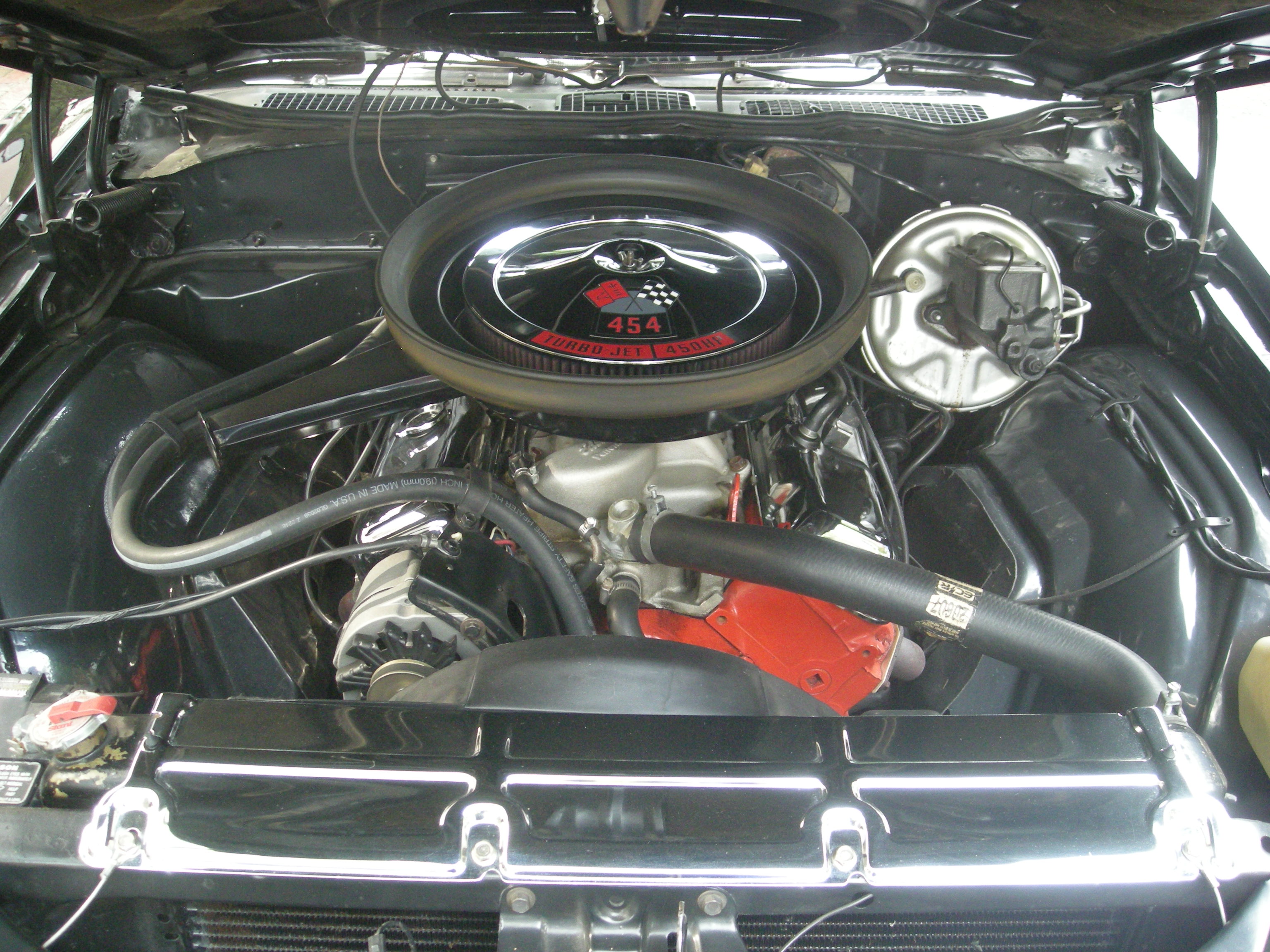
The Chevrolet 454 engine produced a formidable range of power outputs, with stock ratings often exceeding 360 horsepower and 425 lb-ft of torque in its most potent forms, such as the LS6 variant. The LS6, specifically found in the 1970 Chevrolet Chevelle SS 454, was officially rated at 450 horsepower and 500 lb-ft of torque, though many believed these figures were deliberately understated by Chevrolet to avoid attracting undue attention from insurance companies and government regulators. For comparison, the standard 454 in the 1971 Chevrolet Corvette was rated at 365 horsepower. By 1976, emissions controls had reduced the output of the standard 454 to around 215 horsepower. Marine versions of the 454 often produced upwards of 300-350 horsepower, tailored for sustained high-RPM operation. Crate engine versions today can easily surpass 500 horsepower with modern modifications.
👥 Key People & Organizations
While no single individual "invented" the 454, its development was a collaborative effort within GM's engineering departments. Key figures in the broader big-block engine program, like Zora Arkus-Duntov, the "father of the Corvette," championed the high-performance V8s that the 454 embodied. The engine was primarily manufactured at GM's Tonawanda Engine Plant in New York. Performance tuning and aftermarket support were heavily influenced by legendary engine builders and racing teams, including figures associated with Speed Engineering and Edelbrock, who developed components to extract even more power from the robust 454 architecture. Chevrolet's own performance parts division, Chevrolet Performance, continues to offer modern iterations of the big-block engine.
🌍 Cultural Impact & Influence
The Chevrolet 454 engine is inextricably linked to the golden age of American muscle cars and the pursuit of raw automotive power. It was the heart of iconic vehicles like the Chevrolet Chevelle SS, the Chevrolet Corvette Stingray, and the Chevrolet Camaro Z28 (though less common in the Z28). Its thunderous exhaust note and neck-snapping acceleration became synonymous with American automotive prowess. Beyond street performance, the 454 found a massive following in drag racing, hot-rodding, and custom car culture, with countless examples being modified and built into dedicated race machines. Its image is deeply embedded in popular culture, appearing in films, music, and video games that celebrate automotive performance and nostalgia, contributing to its enduring Vibe Score of 92.
⚡ Current State & Latest Developments
While the 454 was phased out of regular production passenger cars by 1976, its story is far from over. Chevrolet Performance continues to offer modern "Connect & Cruise" crate engine packages featuring updated versions of the big-block, often with electronic fuel injection and improved emissions compliance, catering to restorers and performance builders. Marine applications remain a significant market, with companies like Indmar and Crusader Engines utilizing variations of the 454 for high-performance boats. The aftermarket for the 454 is robust, with companies like Scat Crankshafts and Dart Machinery producing upgraded components for enthusiasts seeking to build or rebuild these legendary powerplants. Interest in classic muscle cars, and thus their engines, has seen a resurgence in the 2020s, keeping the 454 relevant.
🤔 Controversies & Debates
One of the primary controversies surrounding the Chevrolet 454, particularly its high-output variants like the LS6, involves the accuracy of its advertised horsepower and torque figures. Many automotive historians and enthusiasts believe Chevrolet deliberately understated these numbers to circumvent regulatory scrutiny and insurance premiums, leading to debates about its true performance potential. Furthermore, the engine's thirst for fuel and its significant emissions output, especially in its original carbureted form, made it a target during the 1970s oil crisis and subsequent environmental regulations, leading to its eventual removal from many production lines. The debate continues regarding whether its raw power justified its environmental impact, a common tension in the history of performance automotive engineering.
🔮 Future Outlook & Predictions
The future of the Chevrolet 454, while not in mainstream automotive production, remains strong in niche markets. Crate engine sales through Chevrolet Performance and aftermarket suppliers are expected to continue as long as demand for classic muscle car restorations and high-performance builds persists. Advancements in fuel injection technology and engine management systems will likely lead to even more efficient and cleaner-burning versions of the big-block, potentially expanding its appeal to a new generation of enthusiasts. The enduring appeal of its massive displacement and torque suggests it will remain a staple in marine applications and specialized racing series for the foreseeable future. However, the broader automotive industry's shift towards electrification, spearheaded by GM's own Ultium platform, casts a long shadow over the long-term viability of internal combustion engines of this nature.
💡 Practical Applications
The Chevrolet 454 engine's practical applications are as diverse as its power output. Its most famous role was as the powerplant for high-performance muscle cars like the Chevrolet Chevelle SS and Chevrolet Corvette, delivering exhilarating acceleration. Beyond street performance, it became a go-to for drag racers seeking immense torque to launch off the line, with many modified 454s dominating quarter-mile tracks. It also found extensive use in marine applications, powering speedboats and offshore racing vessels where its robust construction and sustained power delivery were crucial. Furthermore, the 454's torque made it suitable for heavy-duty applications, including some motorhomes and even armored vehicles, showcasing its versatility. Today, it's a popular choice for hot-rod builders and custom car fabricators.
Key Facts
- Category
- technology
- Type
- topic