
Contents
Overview
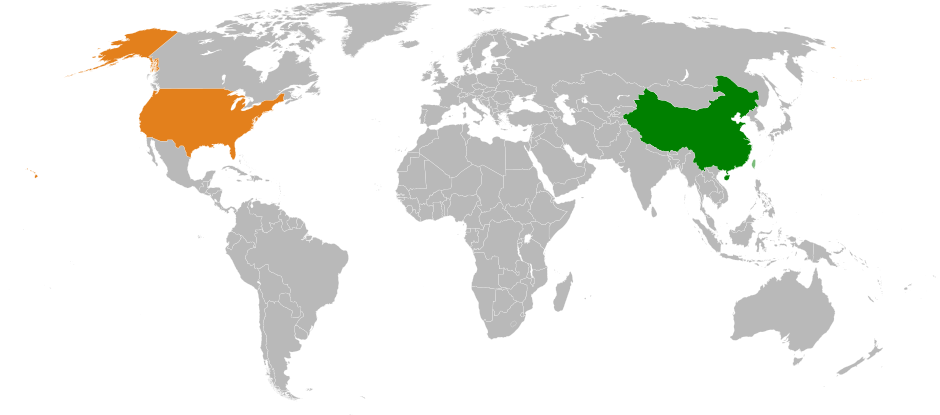
The relationship between the People's Republic of China (PRC) and the United States (US) is a defining geopolitical dynamic of the 21st century, characterized by deep economic entanglement, intense strategic competition, and persistent ideological friction. Since the normalization of relations, the two global powers have navigated a complex web of cooperation and conflict, marked by disputes over trade practices, human rights, territorial claims in the South China Sea, and the political status of Taiwan. As of 2025, the US and China represent the world's first and second-largest economies by nominal GDP, underscoring their profound economic interconnectedness. This intricate relationship, often described as a "complex interdependence," continues to shape international affairs, global trade, and technological development, with ongoing debates about its trajectory towards either managed competition or outright confrontation.
🎵 Origins & History
The US recognized the Republic of China (ROC) government before normalization, which then retreated to Taiwan. Full diplomatic ties were established under President Jimmy Carter. The US acknowledged the PRC's position on 'One China' while maintaining unofficial relations with Taiwan through the Taiwan Relations Act.
⚙️ How It Works
The operational framework of China–United States relations is a multifaceted system involving diplomatic, economic, and security dimensions. Diplomatic engagement occurs through formal channels like embassies in Beijing and Washington D.C., as well as multilateral forums such as the United Nations Security Council and the World Trade Organization. Economically, the relationship is defined by massive bilateral trade volumes, significant foreign direct investment flows, and complex supply chain interdependencies, managed through trade agreements, tariffs, and ongoing negotiations. The security aspect involves military-to-military communication channels aimed at de-escalation, particularly concerning flashpoints like the South China Sea and Taiwan Strait, alongside broader geopolitical competition in areas like artificial intelligence and 5G technology. The strategic competition is often framed through lenses of national security, economic competitiveness, and ideological differences, with both nations employing various tools, including sanctions, export controls, and diplomatic alliances, to advance their interests.
📊 Key Facts & Numbers
As of 2025, the economic scale of China–United States relations is staggering. The US is China's third-largest trading partner. In terms of GDP, the US and China are the world's largest and second-largest economies respectively. Their combined nominal GDP accounts for roughly 44.2% of the global total. The number of Chinese students studying in the US has historically been significant, often exceeding 300,000 annually before recent geopolitical shifts, representing a key cultural and educational exchange. Military spending also highlights their global standing, with the US and China being the top two global military spenders.
👥 Key People & Organizations
Key figures and organizations profoundly shape China–United States relations. On the US side, Presidents like Joe Biden and his predecessor Donald Trump have implemented distinct policies, from Trump's trade war to Biden's emphasis on alliances and strategic competition. Secretaries of State such as Antony Blinken and former officials like Mike Pompeo have been central to diplomatic maneuvering. Major American corporations like Apple Inc., Tesla, Inc., and Qualcomm have substantial business interests in China, influencing economic policy debates. On the Chinese side, President Xi Jinping has consolidated power and pursued a more assertive foreign policy, with Premier Li Qiang overseeing economic affairs. The Chinese Communist Party (CCP) is the ultimate decision-making body, with its Politburo Standing Committee setting strategic direction. Organizations like the Ministry of Foreign Affairs of the PRC and the People's Liberation Army (PLA) are critical state actors. Think tanks and academic institutions in both countries, such as the Carnegie Endowment for International Peace and Tsinghua University, also play roles in shaping discourse and policy recommendations.
🌍 Cultural Impact & Influence
The cultural resonance of China–United States relations is vast, impacting global perceptions and domestic narratives in both nations. Hollywood films often portray China in various roles, from economic partner to geopolitical rival, influencing Western public opinion. Conversely, Chinese media frequently highlights perceived US hegemony and interference, fostering nationalist sentiment. The flow of cultural products, from Chinese cuisine and martial arts films to American music and fashion, has long shaped lifestyles globally. Educational exchanges, though increasingly scrutinized, have historically fostered mutual understanding, with generations of students returning home to influence policy and business. The rise of Chinese technology firms like Tencent and Alibaba Group has also introduced Chinese digital culture and platforms to global audiences, sometimes clashing with Western tech giants like Google and Meta Platforms. The ongoing debate over human rights in China, particularly concerning Xinjiang and Hong Kong, has significant cultural and ethical implications worldwide, often amplified by international NGOs and media.
⚡ Current State & Latest Developments
As of early 2025, China–United States relations are defined by a heightened state of strategic competition and cautious engagement. The Biden administration has continued to frame the relationship as one of competition, cooperation where possible, and confrontation where necessary. High-level diplomatic meetings, such as the summit between President Biden and President Xi Jinping in November 2023, aim to manage tensions and prevent miscalculation, particularly concerning Taiwan and South China Sea disputes. Trade relations remain contentious, with many Trump-era tariffs still in place and ongoing investigations into Chinese trade practices. The US has also intensified efforts to restrict China's access to advanced semiconductor technology, exemplified by actions taken by the Department of Commerce. China, in turn, has continued its military modernization and assertive diplomacy, while also seeking to bolster its economic resilience through initiatives like the Belt and Road Initiative. The ongoing war in Ukraine has also seen China maintain a delicate balancing act, refusing to condemn Russia's invasion while also engaging in trade with Western nations.
🤔 Controversies & Debates
The China–United States relations are fraught with significant controversies and debates. A central point of contention is China's economic model, with the US and its allies alleging unfair trade practices, intellectual property theft, and state-sponsored industrial policies t
Key Facts
- Category
- politics
- Type
- topic