
Contents
- 🧠 What is Cognitive Linguistics?
- 🧐 Key Principles & Concepts
- ⚖️ Cognitive Linguistics vs. Other Approaches
- 💡 Who Benefits from Studying This?
- 📚 Core Texts & Foundational Works
- 🎓 Academic Pathways & Institutions
- 🌐 Online Resources & Communities
- 🚀 Future Directions & Debates
- Frequently Asked Questions
- Related Topics
Overview
Cognitive linguistics views language not as an autonomous system, but as intrinsically linked to human cognition. It posits that linguistic structures, such as grammar and vocabulary, are shaped by general cognitive processes like perception, memory, and categorization. This perspective challenges traditional linguistic theories by emphasizing the embodied and experiential nature of language, arguing that meaning is constructed through our interaction with the world. Key concepts include conceptual metaphor, metonymy, and image schemas, which explain how abstract ideas are understood through concrete experiences. Understanding cognitive linguistics offers a powerful lens for analyzing communication, learning, and the very structure of human thought.
🧠 What is Cognitive Linguistics?
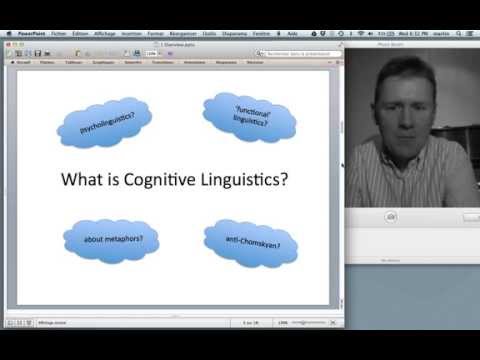
Cognitive linguistics is a vibrant field that views language not as an abstract, rule-governed system, but as an integral part of human cognition. Unlike traditional approaches that isolate language, cognitive linguists see linguistic structures as direct reflections of how we conceptualize the world. This means understanding grammar, meaning, and usage offers profound insights into our general mental architecture, from perception and memory to reasoning and categorization. It's a perspective that fundamentally links the way we speak to the way we think, challenging the notion of a distinct, innate language module.
🧐 Key Principles & Concepts
At its heart, cognitive linguistics posits that meaning is conceptualization. Concepts are not static entities but are dynamic, embodied, and context-dependent. Key ideas include conceptual metaphor (e.g., ARGUMENT IS WAR), where abstract concepts are understood through more concrete ones, and conceptual metonymy (e.g., 'the White House' for the US administration), which uses one entity to stand for another. Embodied cognition is also central, suggesting our physical experiences shape our understanding of language. Prototype theory argues that categories are organized around typical examples, not strict definitions.
⚖️ Cognitive Linguistics vs. Other Approaches
Cognitive linguistics stands in contrast to generative linguistics, particularly the Chomskyan tradition, which posits an innate Universal Grammar separate from general cognition. While generative grammar focuses on abstract syntactic structures and the 'competence' of an ideal speaker, cognitive linguistics emphasizes the 'performance' and the role of usage and experience. It also diverges from formal semantics, which defines meaning based on truth conditions in an external reality, by grounding meaning in subjective conceptualization and embodied experience.
💡 Who Benefits from Studying This?
This field is invaluable for anyone interested in the deep structure of human thought and communication. Linguists, psychologists, philosophers, and computer scientists working on NLP find its insights crucial. Educators can use its principles to develop more effective language teaching methods, while designers of AI systems can build more human-like understanding. Anyone curious about how our minds construct meaning from the words we use will find cognitive linguistics deeply rewarding.
📚 Core Texts & Foundational Works
For those diving into cognitive linguistics, foundational texts are essential. George Lakoff and Mark Johnson's "Metaphors We Live By" (1980) is a landmark, introducing the concept of conceptual metaphor. Ronald Langacker's "Foundations of Cognitive Grammar" (1987, 1991) provides a comprehensive theoretical framework. Other critical works include Talmy's "Toward a Cognitive Semantics" (2000) and Eleanor Rosch's early work on prototype theory in the 1970s, which laid crucial groundwork for understanding categorization.
🎓 Academic Pathways & Institutions
Academic study of cognitive linguistics is available at numerous universities worldwide. Leading departments often house researchers in linguistics, psychology, and cognitive science. Look for programs with faculty specializing in conceptual metaphor, frame semantics, construction grammar, or embodied cognition. Institutions like the University of California, Berkeley; the University of California, San Diego; and Radboud University in the Netherlands are notable hubs for this research.
🌐 Online Resources & Communities
Beyond formal education, a wealth of online resources exists. The Cognitive Linguistics Society website offers journals, conference information, and member directories. Online forums and mailing lists dedicated to linguistic theory often feature discussions on cognitive approaches. Many university departments provide open-access lecture notes and syllabi. Following prominent cognitive linguists on academic social networks like Academia.edu or ResearchGate can also provide direct access to their latest work and ongoing debates.
🚀 Future Directions & Debates
The future of cognitive linguistics is intertwined with advances in neuroscience and computational linguistics. Researchers are increasingly using brain imaging techniques to explore the neural correlates of conceptualization and language processing, seeking to bridge the gap between abstract theory and biological reality. Debates continue regarding the precise nature of innate linguistic knowledge versus learned conceptual structures, and how best to model complex linguistic phenomena computationally. The integration of embodied experience into AI remains a significant frontier.
Key Facts
- Year
- 1980
- Origin
- Developed in the late 1970s and early 1980s, with key figures like George Lakoff and Ronald Langacker articulating its core tenets, emerging as a distinct field from generative linguistics and other cognitive sciences.
- Category
- Academic Disciplines
- Type
- Academic Field
Frequently Asked Questions
Is cognitive linguistics a single theory or a collection of theories?
Cognitive linguistics is best understood as an approach or a framework that encompasses a number of complementary and sometimes overlapping theories. While they share core assumptions, such as the link between language and cognition, specific theories like frame semantics, construction grammar, and conceptual metaphor theory offer distinct models and analytical tools.
How does cognitive linguistics differ from psycholinguistics?
While both fields study the relationship between language and the mind, psycholinguistics often focuses on the psychological processes of language acquisition, comprehension, and production, frequently employing experimental methods. Cognitive linguistics, on the other hand, is more concerned with the nature of linguistic meaning as conceptualization and how language reflects broader cognitive structures, often drawing on linguistic analysis and philosophical reasoning.
What is the role of 'usage' in cognitive linguistics?
Usage is paramount in cognitive linguistics. Unlike theories that posit abstract rules, cognitive linguists believe that language is learned and structured through repeated exposure to and use of linguistic forms in context. This usage-based perspective emphasizes how patterns emerge from communicative interactions and how speakers acquire linguistic knowledge through experience.
Can cognitive linguistics explain all aspects of language?
Cognitive linguists aim to provide comprehensive explanations, but like any field, it faces challenges. Explaining highly abstract or formal aspects of language, or fully integrating the biological basis of language, are ongoing areas of research and debate. The field is dynamic, constantly evolving to address new questions and integrate findings from related disciplines.
Where can I find introductory materials on cognitive linguistics?
Many university websites offer introductory lectures or course materials. Books like "Cognitive Linguistics: An Introduction" by William Croft and D. Alan Cruse are excellent starting points. Online encyclopedias and reputable academic blogs also provide accessible overviews of key concepts and thinkers in the field.
What are some practical applications of cognitive linguistics?
Practical applications include improved methods for language teaching, more effective UI/UX design by understanding user conceptualizations, advancements in AI for natural language understanding, and insights into persuasion techniques by analyzing how metaphors and framing influence thought.