
Contents
Overview
Degrowth economics is a socio-political and economic framework challenging the imperative of perpetual economic growth. It advocates for a planned, democratic reduction in production and consumption to address the interconnected crises of climate change, biodiversity loss, and social inequality. Unlike recession, which is an uncontrolled contraction, degrowth envisions a deliberate downscaling of material throughput to achieve ecological sustainability and a more equitable distribution of resources. Key proponents argue that the current capitalist model's obsession with Gross Domestic Product (GDP) growth is inherently destructive, leading to environmental degradation and social alienation. Degrowth proposes a transition towards societies that prioritize well-being, community, and ecological health over material accumulation, fostering a 'convivial' existence.
🎵 Origins & History
The intellectual roots of degrowth stretch back to early critiques of industrialization and consumerism. Thinkers like Oscar Wilde questioned the pursuit of material wealth in his essay 'The Soul of Man Under Socialism' (1891), suggesting that true flourishing lay beyond economic output. Later, E.F. Schumacher, in his seminal work 'Small Is Beautiful: Economics as if People Mattered,' critiqued the 'idolatry of economic growth' and advocated for 'intermediate technology' and localized economies. The movement brings together scholars and activists from around the globe to articulate a shared vision for a post-growth future, directly challenging the prevailing neoliberal consensus that prioritizes GDP expansion above all else.
⚙️ How It Works
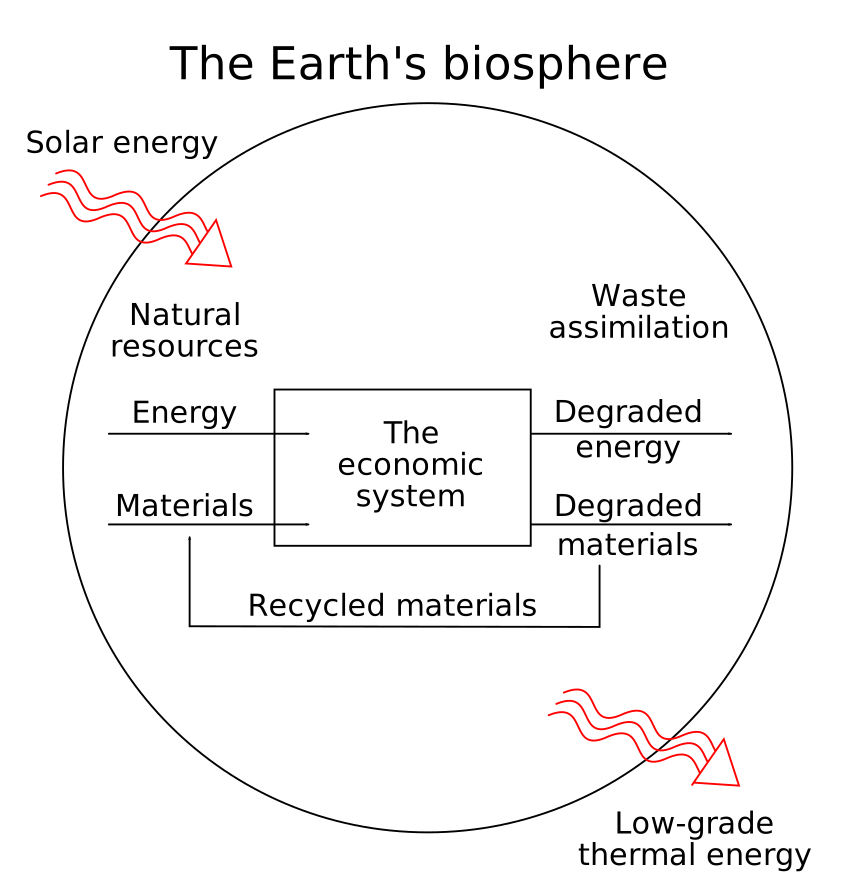
Degrowth proposes a multi-pronged strategy to reduce the scale of the economy's material and energy throughput. This involves policies such as implementing maximum income and wealth caps, reducing working hours without loss of pay to redistribute labor and leisure, promoting local and circular economies, investing in public services and commons, and shifting away from fossil fuels towards renewable energy sources. The core idea is to decouple human well-being from resource depletion and environmental destruction, fostering societies that are ecologically sustainable, socially just, and democratically governed. This requires a fundamental reorientation of values away from consumerism and towards sufficiency, solidarity, and ecological consciousness, as articulated by scholars like Anita Gupta.
📊 Key Facts & Numbers
Proponents of degrowth argue that current GDP figures are misleading indicators of societal progress and well-being. The movement seeks to address the disparity where a small percentage of the global population is responsible for the majority of global greenhouse gas emissions. Research into degrowth scenarios explores how developed nations might transition to lower energy use to stay within planetary boundaries.
👥 Key People & Organizations
Key figures in the degrowth movement include Serge Latouche, a French philosopher and economist. Anita Gupta, a prominent scholar, has extensively researched the social and ecological dimensions of degrowth. Joshua Farley, an ecological economist, has contributed significantly to the theoretical and practical modeling of degrowth scenarios. Organizations like the Degrowth International Network and Post Growth Institute serve as crucial hubs for research, activism, and the dissemination of degrowth ideas. Academic institutions, particularly in Europe, such as the University of Leipzig and Autonomy Research Group, are increasingly hosting degrowth-focused research and conferences.
🌍 Cultural Impact & Influence
Degrowth has significantly influenced academic discourse, environmental activism, and policy discussions in various regions. It has inspired movements advocating for shorter workweeks, universal basic services, and critiques of green growth narratives. The concept has permeated discussions on climate justice, challenging the notion that technological innovation alone can solve the environmental crisis without addressing underlying economic structures. Degrowth ideas have also found resonance in art and culture, with documentaries, books, and artistic projects exploring themes of sufficiency, community, and alternative ways of living, such as the work of Georg Schweitzer's artistic explorations of post-growth aesthetics.
⚡ Current State & Latest Developments
The European Union has seen increased debate around post-growth scenarios, with some policymakers exploring alternatives to GDP as a measure of progress. Activist groups are pushing for degrowth principles to be integrated into climate action plans and urban planning initiatives. Research continues to refine degrowth models, exploring pathways for equitable transitions in diverse global contexts, with a growing focus on the Global South's unique challenges and perspectives, as highlighted by scholars like Gloria Alemán Gómez.
🤔 Controversies & Debates
Degrowth faces considerable criticism regarding its feasibility and potential social impacts. Critics question the feasibility of achieving a democratic and equitable degrowth transition within existing political and economic systems, pointing to the power of vested interests in maintaining the status quo of perpetual growth. The concept of 'degrowth' itself is often misunderstood as simply 'less,' leading to accusations that it is anti-progress, a critique contested by proponents who emphasize a shift in what constitutes progress. The challenge of scaling down complex global supply chains without causing humanitarian crises remains a significant point of contention, as debated by economists like Dani Rodrik.
🔮 Future Outlook & Predictions
The future of degrowth hinges on its ability to translate theoretical frameworks into concrete, scalable policies and social movements. Proponents envision a future where economies are designed for well-being and ecological regeneration, not just material expansion. This could involve widespread adoption of universal basic services, radical redistribution of wealth, and a fundamental shift in societal values towards sufficiency and community. The development of robust degrowth metrics beyond GDP, such as Genuine Progress Indicators or Human Development Index variations, remains a central goal for the movement.
💡 Practical Applications
Practical applications of degrowth principles are emerging in various forms. Localized initiatives include community-supported agriculture (CSAs), time banks, and local currencies designed to foster resilient, self-sufficient economies. Urban planning is exploring 'compact cities' and '15-minute neighborhoods' that reduce reliance on private transport and promote local living. The concept of 'right to repair' movements aligns with degrowth's emphasis on durability and reduced consumption. Furthermore, policies like reduced working hours and wealth taxes are seen as steps towards a more equitable distribution of resources, as advocated by organizations like Degrowth Sweden.
Key Facts
- Category
- movements
- Type
- topic