
Contents
Overview
The conceptual genesis of the 'developing nations forum' can be traced back to the post-colonial era, a period marked by newly independent nations grappling with the legacies of economic exploitation and the urgent need for self-determination. While the term 'developing nations' itself became prominent in the mid-20th century, the formal recognition of the most disadvantaged among them arrived with the United Nations' first list of Least Developed Countries (LDCs) in 1971, stemming from UN Resolution 2768 (XXVI). This designation, based on criteria like low income, human asset deficits, and economic vulnerability, provided a concrete framework for international engagement. Early forums often convened under the umbrella of the United Nations General Assembly and the Non-Aligned Movement, where leaders from countries like India (under Jawaharlal Nehru) and Egypt (under Gamal Abdel Nasser) articulated shared concerns about global economic inequality and the need for a more equitable international order. The Group of 77 (G77), established in 1964, also played a pivotal role in consolidating the voice of developing nations, advocating for systemic changes in trade, finance, and development assistance.
⚙️ How It Works
The 'developing nations forum' operates not as a single, monolithic entity but as a dynamic and multifaceted concept that manifests in various forms. At its core, it functions as a platform for collective bargaining and advocacy. This can take the shape of formal international conferences, such as the UNCTAD sessions, where representatives from developing countries negotiate trade policies and development strategies. It also includes regional groupings like the African Union or the ASEAN, which serve as regional forums for coordinating economic and political agendas. Furthermore, the concept underpins initiatives within multilateral institutions like the World Bank and the International Monetary Fund (IMF), where developing nations seek access to capital and technical assistance. The 'forum' is thus an ongoing process of dialogue, negotiation, and cooperation, driven by the shared goal of achieving sustainable development and reducing global disparities.
📊 Key Facts & Numbers
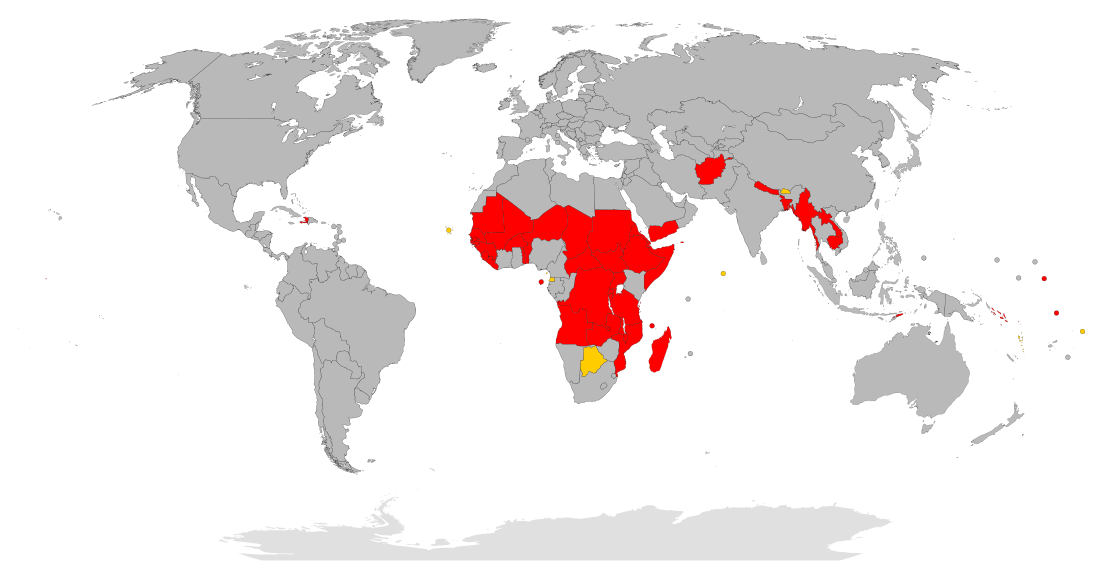
The scale of development disparities is stark: the United Nations identifies countries as Least Developed Countries (LDCs), home to approximately 1.1 billion people, who collectively account for less than 2% of global GDP. The GNI per capita threshold for LDC status is currently below $1,088, a figure dramatically lower than the average GNI per capita in developed nations, which often exceeds $50,000. Human asset indices, measuring health and education, reveal significant gaps, with LDCs often scoring below 60 compared to scores above 80 in high-income countries. Economic vulnerability is also a critical factor; for instance, agricultural production instability affects over 40% of the population in many LDCs, making them highly susceptible to climate shocks and price volatility. Despite these challenges, some developing nations have achieved remarkable progress; Vietnam's economy, for example, grew by an average of 6.8% annually between 1990 and 2022, lifting millions out of poverty.
👥 Key People & Organizations
Key figures and organizations have shaped the discourse around developing nations. Jawaharlal Nehru, the first Prime Minister of India, was a principal architect of the Non-Aligned Movement, advocating for developing nations to chart their own course independent of Cold War blocs. Mahbub ul Haq, a Pakistani economist, was instrumental in developing the Human Development Index (HDI), shifting focus from purely economic growth to broader measures of well-being. The United Nations Development Programme (UNDP) plays a crucial role in coordinating development efforts and advocating for the needs of developing countries. Within the UN system, the Office of the High Representative for the Least Developed Countries, Landlocked Developing Countries and Small Island Developing States (OHRLLS) specifically champions the interests of the most vulnerable nations. Regional bodies like the African Union Commission and the Asian Development Bank (ADB) also serve as vital platforms for developing nations to collaborate and advance their agendas.
🌍 Cultural Impact & Influence
The concept of a 'developing nations forum' has profoundly influenced global governance and international relations. It has been instrumental in shaping agendas at major international summits, leading to the establishment of development goals like the Millennium Development Goals (MDGs) and the Sustainable Development Goals (SDGs). The persistent advocacy from developing nations has also contributed to reforms within international financial institutions, aiming for greater representation and responsiveness to their needs. Culturally, the discourse has fostered a greater global awareness of development challenges, influencing academic research, media coverage, and public opinion in developed countries. The rise of global South solidarity, exemplified by initiatives like BRICS (Brazil, Russia, India, China, South Africa), demonstrates the growing influence and interconnectedness of developing economies on the world stage, challenging traditional power dynamics.
⚡ Current State & Latest Developments
In the current landscape of 2024-2025, the developing nations forum is increasingly focused on navigating the complex challenges of the post-pandemic world and the escalating climate crisis. Discussions frequently revolve around equitable access to vaccines and healthcare, debt relief for heavily indebted nations, and the urgent need for climate finance to support adaptation and mitigation efforts. The G20 has seen increased engagement from developing nations seeking a stronger voice in global economic governance, particularly concerning issues like international taxation and the reform of multilateral development banks. The rise of digital technologies presents both opportunities and challenges, with discussions centering on bridging the digital divide and ensuring inclusive access to innovation. Geopolitical shifts, including the ongoing conflicts and trade tensions, also necessitate a coordinated response from developing nations to protect their economic interests and pursue pathways to sustainable growth.
🤔 Controversies & Debates
The very notion of a 'developing nations forum' is not without its controversies. Critics often question the efficacy of these forums, arguing that they can devolve into forums for rhetoric with little tangible action, particularly when consensus among diverse developing nations proves elusive. The criteria for classifying countries as 'developing' or 'least developed' have also been debated, with some arguing they are outdated or fail to capture the nuances of diverse national contexts. There's also tension between the desire for international aid and the push for self-reliance and fair trade practices, with some developing nations wary of dependency on external assistance. Furthermore, the influence of powerful developing nations within these forums can sometimes overshadow the concerns of the smallest and most vulnerable economies, leading to internal power dynamics that complicate collective action.
🔮 Future Outlook & Predictions
Looking ahead, the future of the developing nations forum is likely to be shaped by the ongoing global push for a more multipolar world order and the imperative to address systemic global challenges. Experts predict a continued emphasis on reforming international financial architecture to better serve the needs of developing economies, potentially through increased capitalisation of institutions like the Asian Infrastructure Investment Bank (AIIB) and the New Development Bank (NDB). The transition to green economies will be a central theme, with developing nations demanding greater support for renewable energy adoption and climate resilience. There's also speculation about the potential for greater South-South cooperation, fostering stronger trade and investment ties among developing countries themselves, reducing reliance on traditional Northern markets. The effectiveness of these future forums will hinge on their ability to t
Key Facts
- Category
- movements
- Type
- topic