
Contents
Overview
The intellectual roots of ecological economics stretch back to early thinkers who recognized the material limits of economies, from Karl Marx's analysis of the metabolic rift between capitalism and nature to William Stanley Jevons's warnings about coal depletion in the 1860s. However, the formal discipline coalesced in the 1980s, spurred by growing awareness of environmental crises like acid rain and ozone depletion, and the limitations of neoclassical economics in addressing them. Key figures like Nicholas Georgescu-Roegen, with his work on entropy and economic processes, laid crucial groundwork. The journal Ecological Economics was founded in 1989 by Robert Costanza and Herman Daly, providing a vital platform for this emerging field. This period saw a deliberate effort to integrate insights from thermodynamics, ecology, and systems thinking into economic analysis, moving away from the abstract equilibrium models of mainstream economics.
⚙️ How It Works
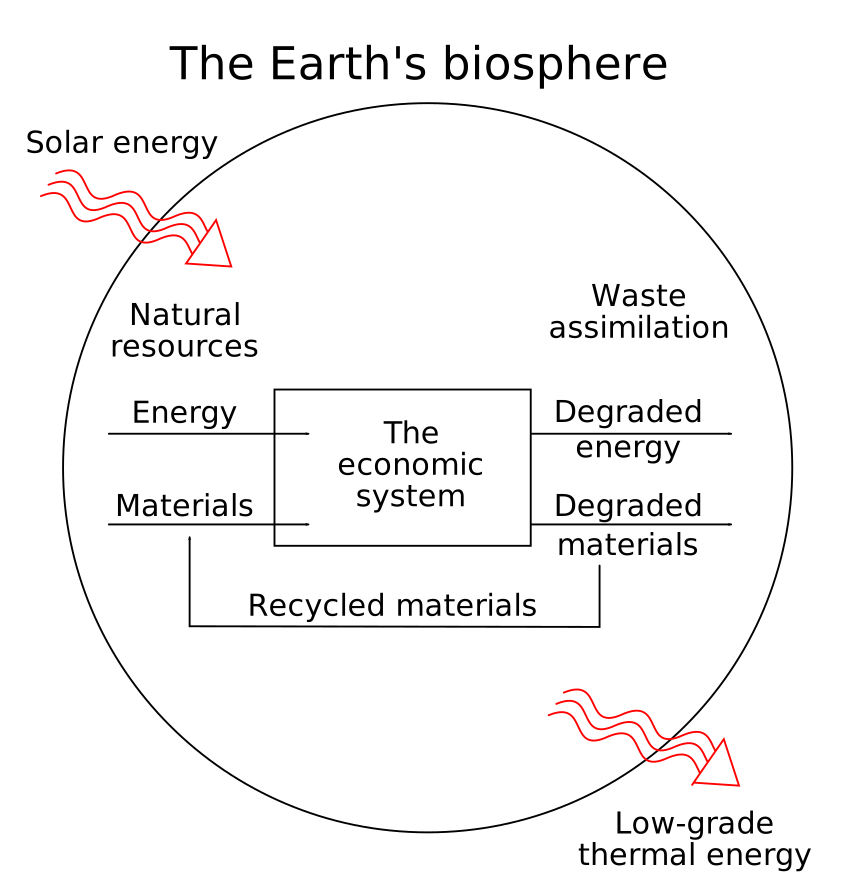
At its core, ecological economics treats the economy as a subsystem of the Earth's ecosystem, acknowledging that all economic activity is ultimately dependent on natural resources and services. It emphasizes the concept of natural capital—the stock of natural assets that provide essential ecosystem services like clean air, water, and climate regulation—and advocates for its preservation. Unlike neoclassical economics, which often assumes substitutability between human-made capital and natural capital (weak sustainability), ecological economics champions 'strong sustainability,' arguing that certain forms of natural capital are irreplaceable. This perspective necessitates a focus on biophysical limits, such as material flow analysis and thermodynamic constraints, to understand economic processes and their environmental impacts.
📊 Key Facts & Numbers
The journal Ecological Economics, a flagship publication, has published over 10,000 articles since its inception in 1989, reflecting the field's growth. Studies within ecological economics often quantify the economic value of ecosystem services, with estimates for global services ranging from $16 trillion to $54 trillion annually, as reported in a widely cited 1997 paper by Robert Costanza and colleagues. Research indicates that global material consumption has more than tripled since 1970, reaching over 100 billion tonnes annually, highlighting the biophysical scale of the challenge. Furthermore, analyses of degrowth scenarios suggest that developed nations may need to reduce their material and energy throughput by 40-70% by 2050 to remain within planetary boundaries.
👥 Key People & Organizations
Pioneering figures like Nicholas Georgescu-Roegen (1906-1994), whose work on entropy provided a thermodynamic foundation, and Herman Daly (1938-2022), a key architect of steady-state economics, are central to the field. Robert Costanza, a prolific researcher, co-founded the journal Ecological Economics and has extensively researched ecosystem valuation. Joshua Farley and Peter Söderbaum are also prominent contemporary scholars. Organizations such as the International Society for Ecological Economics (ISEE) and regional chapters like the European Society for Ecological Economics (ESEE) foster academic exchange and collaboration, bringing together researchers from diverse backgrounds and institutions globally.
🌍 Cultural Impact & Influence
Ecological economics has significantly influenced academic discourse, pushing environmental and resource economics towards more biophysically grounded analyses. It has provided a critical counterpoint to growth-centric economic models, fostering debates on alternative economic paradigms like degrowth, doughnut economics, and post-growth economics. Its concepts, such as natural capital and ecosystem services, have permeated policy discussions, even if their full implications are often diluted. The field's emphasis on intergenerational equity and intrinsic value has also resonated within environmental ethics and sustainability science circles, shaping public understanding of humanity's place within the biosphere.
⚡ Current State & Latest Developments
In 2024, ecological economics continues to grapple with the escalating climate crisis and biodiversity collapse. Research is increasingly focused on developing practical policy frameworks for just transitions away from fossil fuels and unsustainable resource extraction. There's a growing emphasis on circular economy principles, but with a critical ecological lens that questions whether a truly circular model can be achieved at current or growing scales of throughput. New modeling approaches are emerging that integrate complex ecological dynamics and social equity considerations more robustly. The field is also engaging more directly with political ecology to understand the power structures that perpetuate environmental degradation.
🤔 Controversies & Debates
A central controversy revolves around the concept of 'strong sustainability' versus 'weak sustainability.' Critics from mainstream economics argue that ecological economics underestimates the potential for technological innovation to overcome resource constraints and that its focus on biophysical limits is overly pessimistic, potentially hindering economic development. Conversely, ecological economists contend that mainstream economics suffers from ']]physical limits blindness' and that its models fail to account for irreversible environmental damage and the true value of natural capital. Debates also persist regarding the feasibility and desirability of degrowth as a policy goal, with disagreements on whether it's a necessary response to ecological overshoot or an impractical impediment to improving living standards, particularly in developing nations.
🔮 Future Outlook & Predictions
The future of ecological economics is likely to be shaped by the urgency of global environmental crises. We can expect a continued push for policy frameworks that embed ecological limits into economic decision-making, potentially leading to more widespread adoption of carbon pricing mechanisms, cap-and-trade systems, and regulations designed to protect biodiversity. The field will likely play a crucial role in designing post-fossil fuel economies and in developing metrics beyond GDP to measure societal well-being, such as Genuine Progress Indicators or Human Development Index variants that incorporate environmental factors. Expect increased integration with climate modeling and earth system science to better forecast and manage ecological-economic interactions.
💡 Practical Applications
Ecological economics offers practical applications across various sectors. In policy-making, it informs the design of environmental regulations, resource management strategies, and climate change mitigation plans, advocating for policies that protect natural capital and ensure intergenerational equity. It provides frameworks for valuing ecosystem services, aiding in land-use planning and conservation efforts, as demonstrated by projects valuing wetlands or forests. The field also influences corporate sustainability reporting by promoting metrics that go beyond financial performance to include environmental and social impacts, encouraging the adoption of circular economy principles and life-cycle assessments to minimize resource depletion and waste.
Key Facts
- Category
- philosophy
- Type
- topic