
Contents
Overview
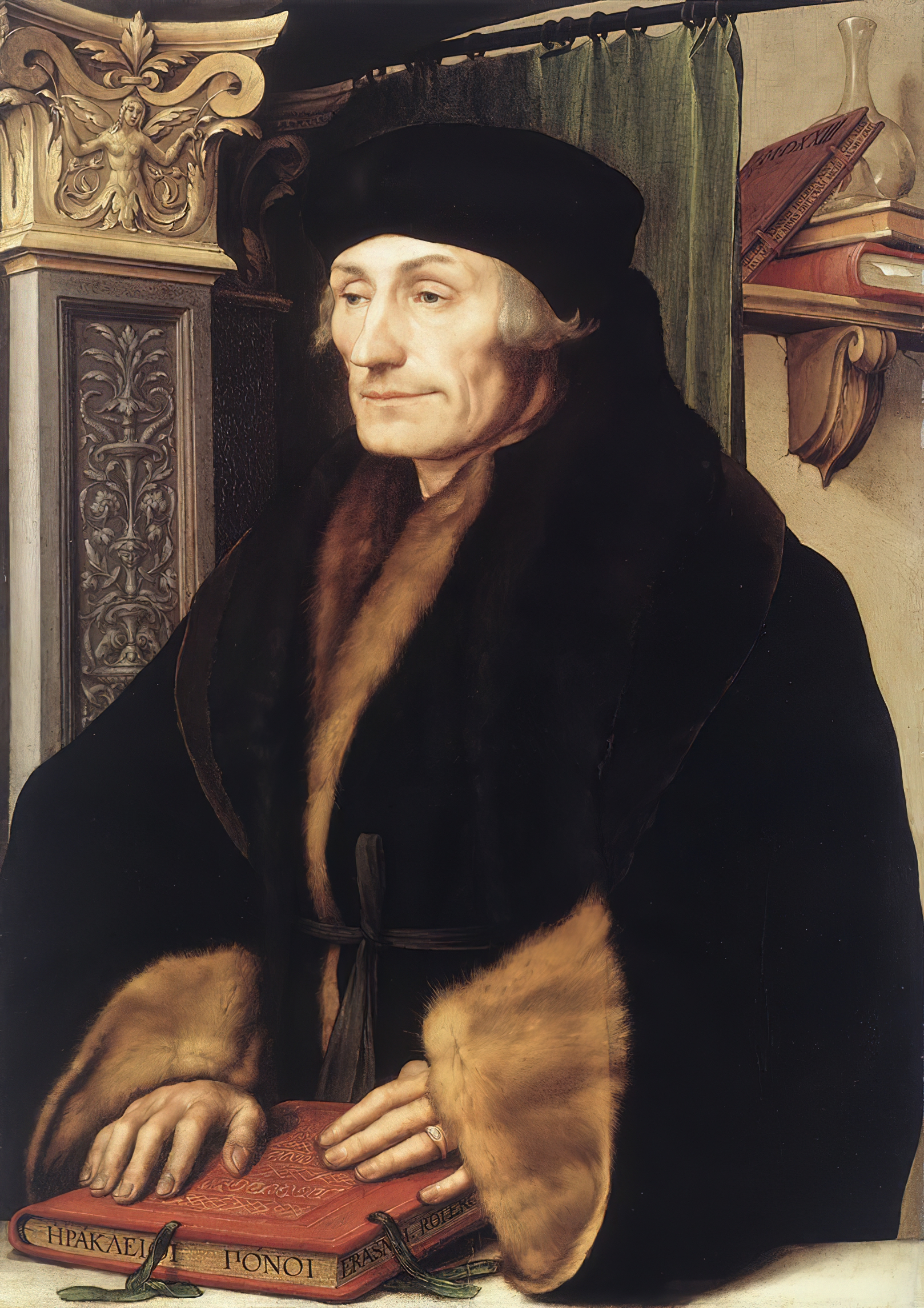
Desiderius Erasmus Roterodamus, known globally as Erasmus of Rotterdam, was a Dutch Renaissance humanist, Catholic theologian, and pioneering philologist whose intellectual output profoundly shaped Western culture. Born in Rotterdam, he became one of the most influential scholars of the Northern Renaissance, renowned for his elegant and natural Latin prose. Erasmus meticulously prepared new editions of the New Testament and the Church Fathers, employing humanist textual criticism that proved vital for both the Protestant Reformation and the Catholic Counter-Reformation. His satirical works, such as 'The Praise of Folly,' used wit to critique societal and religious absurdities, cementing his reputation as a critical yet devout thinker. He navigated a complex religious and political landscape, advocating for reform within the Catholic Church while famously refusing to fully align with the burgeoning Protestant movement, a stance that defined much of his later life and legacy. Erasmus died in Basel, leaving behind a vast body of work that continues to be studied for its insights into early modern thought, textual scholarship, and the enduring power of intellectual critique.
🎵 Origins & History
Desiderius Erasmus Roterodamus was born in Rotterdam. Illegitimate son of a priest and his housekeeper, his early life was marked by the constraints of his birth. He received a rigorous education at the St. Jerome's Monastery in Deventer, under the tutelage of Robert Gaguini, and later at the Collège de Montaigu in Paris, where he was exposed to scholasticism but found its methods stifling. Ordained a Catholic priest, he secured papal dispensation from his vows of enclosure, allowing him to pursue his scholarly ambitions across Europe. His early travels and studies in England, particularly his encounters with Thomas More and John Colet, solidified his commitment to humanism and the study of classical texts. This period marked the genesis of his lifelong dedication to philology and theological scholarship, setting the stage for his influential career.
⚙️ How It Works
Erasmus's intellectual engine ran on a potent blend of classical philology and Christian theology, a methodology he termed 'philosophia Christi.' He applied humanist textual criticism, a rigorous approach to understanding ancient texts in their original languages and historical contexts, to sacred scriptures. His most significant scholarly endeavor was the preparation of new editions of the New Testament and Latin, meticulously comparing various manuscripts to produce a more accurate and readable text than the standard Vulgate. This critical approach extended to the Church Fathers, whose works he also edited and translated. His educational philosophy emphasized eloquence, virtue, and a return to the original sources of Christian thought, aiming to cultivate well-rounded individuals capable of critical engagement with both classical wisdom and religious doctrine. This method was not merely academic; it was a tool for spiritual renewal and intellectual reform.
📊 Key Facts & Numbers
Erasmus's prolific output resulted in an estimated 30,000 pages of published work, making him one of the most widely read authors of his time. His 1516 Greek New Testament, the 'Novum Instrumentum omne,' was printed by Johann Froben and saw three editions during his lifetime. His satirical masterpiece, 'The Praise of Folly,' achieved immense popularity, with translations into numerous languages. Over 3,000 of his letters survive, providing invaluable insights into the intellectual currents of the 16th century. By the time of his death, Erasmus had established himself as a preeminent intellectual figure, with his works circulating widely among scholars, clergy, and educated elites across the continent.
👥 Key People & Organizations
Erasmus's intellectual circle was vast and influential. Thomas More, the English humanist and statesman, was a close friend and correspondent, famously depicted in Erasmus's 'The Praise of Folly.' John Colet, an English theologian, significantly influenced Erasmus's early humanist leanings and biblical scholarship. His primary publisher, Johann Froben of Basel, was instrumental in disseminating Erasmus's works, including his groundbreaking Greek New Testament. Erasmus also engaged with key figures of the Reformation, such as Martin Luther, though their theological differences ultimately led to a public dispute over free will. He held academic positions at the Old University of Leuven and later lectured at Queens' College, Cambridge, further embedding him within the academic institutions of his era. His patronage and intellectual exchanges with figures like Emperor Charles V and various popes highlight his broad influence.
🌍 Cultural Impact & Influence
Erasmus's impact on Western thought is immeasurable. His critical editions of the New Testament provided the textual foundation for Martin Luther's German translation and William Tyndale's English version, fundamentally altering the accessibility and interpretation of scripture. 'The Praise of Folly' satirized the corruption and ignorance within the Church and society, influencing generations of satirists and social critics, including Jonathan Swift and Voltaire. His educational reforms, emphasizing a return to classical learning and eloquent expression, shaped curricula across European universities for centuries. He championed a more personal, internalized form of piety, known as 'philosophia Christi,' which resonated with many seeking reform within Catholicism and indirectly influenced the spiritual underpinnings of Protestantism. His advocacy for peace and his critique of warfare, particularly in 'The Complaint of Peace,' continue to echo in pacifist movements today.
⚡ Current State & Latest Developments
While Erasmus himself is a figure of history, his intellectual legacy remains vibrantly alive. Contemporary scholars continue to analyze his extensive correspondence and writings for nuanced understandings of early modern intellectual history, textual criticism, and the complex relationship between humanism and religion. His editions of classical texts and the New Testament are foundational for modern biblical scholarship, and his satirical methods are still studied in literature and rhetoric. Institutions like the Erasmus University Rotterdam bear his name, continuing his spirit of critical inquiry and interdisciplinary study. The ongoing debates about religious tolerance, the role of reason in faith, and the critique of institutional power all find echoes in Erasmus's life and work, making his ideas relevant to contemporary discussions.
🤔 Controversies & Debates
Erasmus found himself in a precarious position during the tumultuous years of the Protestant Reformation. While his critiques of Church abuses and his emphasis on scripture resonated with reformers, he staunchly refused to break with the Catholic Church, fearing the schism and violence that religious division could unleash. This stance led to accusations of hypocrisy from both sides: Protestants saw him as too timid, while Catholics viewed his criticisms and textual work as dangerously close to heresy. His famous debate with Martin Luther over free will (Erasmus defending it, Luther denying it) publicly estranged them. Furthermore, his advocacy for religious tolerance and his nuanced approach to theological disputes were often at odds with the increasingly dogmatic and confrontational atmosphere of the era, leading to his works being placed on the Index of Forbidden Books by the Catholic Church after his death.
🔮 Future Outlook & Predictions
The future of Erasmus's legacy lies in its continued relevance to ongoing debates about intellectual freedom, religious pluralism, and the critique of power. As societies grapple with polarization and the challenges of misinformation, Erasmus's commitment to reasoned discourse, textual accuracy, and the pursuit of peace offers a compelling model. His emphasis on education as a means of cultivating critical thinking and ethical character remains a vital aspiration for educational institutions worldwide. Future scholarship may uncover new dimensions of his thought through advanced digital humanities approaches to his vast corpus of letters and writings, potentially revealing further connections to contemporary philosophical and theological discussions. The enduring tension between reform and schism, a central theme in Erasmus's life, will likely continue to be a defining characteristic of religious and political discourse.
💡 Practical Applications
Erasmus's work has direct practical applications in several fields. His methods of textua
Key Facts
- Category
- philosophy
- Type
- topic