
Contents
Overview
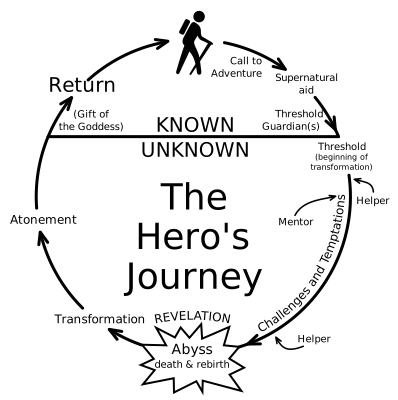
The heroic journey, often termed the 'monomyth,' is a narrative archetype identified across global myths and stories, detailing a protagonist's departure from the ordinary world into a realm of challenge, their triumph over adversity, and their return with newfound wisdom or power. This pattern describes a cyclical structure: the Call to Adventure, the Crossing of the Threshold, the Road of Trials, the Ordeal, the Reward, and the Road Back, culminating in Resurrection and the Return with the Elixir. It is posited that this fundamental story structure reflects deep psychological truths and shared human experiences, resonating across diverse cultures and historical periods, from ancient epics like The Odyssey to modern blockbusters like Star Wars. The monomyth's enduring appeal lies in its ability to explore themes of courage, sacrifice, self-discovery, and the transformative power of facing the unknown.
🎵 Origins & History
The concept of a universal heroic narrative predates formal academic study, appearing in oral traditions and ancient texts worldwide. Early attempts to codify these patterns include Lord Raglan's work, which outlined characteristics common to heroes, and Otto Rank's psychoanalytic interpretations of myth. However, it was Joseph Campbell, deeply influenced by Carl Jung's theories of archetypes and the collective unconscious, who synthesized these observations into the widely recognized 'monomyth.' Campbell's comparative mythology research led him to identify a recurring narrative sequence in myths from cultures as disparate as ancient Egypt, India, Greece, and indigenous American traditions, culminating in his publication that would shape literary analysis and storytelling.
⚙️ The Monomyth Structure
Campbell's monomyth, as detailed in The Hero with a Thousand Faces, typically comprises three main stages: Departure, Initiation, and Return. The Departure begins with the hero's ordinary world, followed by the Call to Adventure, refusal of the call, meeting with a mentor, and crossing the first threshold into the unknown. The Initiation phase involves the Road of Trials, encountering allies and enemies, approaching the innermost cave, facing the ordeal (a central crisis), seizing the reward, and then beginning the Road Back. The Return stage includes the climax of Resurrection (a final test or purification) and the hero's return with the elixir, boon, or knowledge to benefit their community.
📊 Key Facts & Numbers
The monomyth has been identified in world myths and legends, demonstrating its pervasive influence. Joseph Campbell's research found commonalities that suggested a universal human psychological framework. The structure has been applied to narratives spanning millennia, from the The Odyssey to the film Star Wars: A New Hope. Studies suggest that stories following the monomyth structure tend to resonate more deeply with audiences, contributing to their enduring popularity and commercial success in the global entertainment market.
👥 Key Figures & Theorists
The most prominent figure associated with the heroic journey is Joseph Campbell, an American mythologist, writer, and lecturer whose work synthesized comparative mythology and psychology. Influenced by Carl Jung and James Joyce, Campbell's research at institutions like Sarah Lawrence College led to his magnum opus. Other key figures include Lord Raglan, whose earlier work cataloged heroic traits, and Otto Rank, a psychoanalyst who explored the hero's birth and separation from the mother. More recently, screenwriters like Christopher Vogler have adapted Campbell's theories for Hollywood, publishing The Writer's Journey which simplified the monomyth for screenwriting purposes.
🌍 Cultural Impact & Influence
The heroic journey archetype has profoundly shaped Western literature, film, and popular culture. Its influence is evident in countless stories, from classical epics like The Iliad and The Aeneid to modern fantasy series like The Lord of the Rings by J.R.R. Tolkien. The structure provides a reliable framework for creators, ensuring narratives possess emotional depth and thematic resonance. It has also been adopted in fields beyond storytelling, influencing therapeutic approaches and personal development methodologies that encourage individuals to view their own life challenges as part of a transformative journey.
⚡ Modern Adaptations
In contemporary media, the heroic journey remains a dominant narrative force. Filmmakers and authors frequently employ its structure, sometimes consciously, sometimes intuitively. For instance, the Marvel Cinematic Universe (MCU), a franchise that has achieved significant global success, heavily relies on variations of the monomyth for its numerous superhero origin stories and team-up sagas. Christopher Vogler's adaptation of Campbell's work, The Writer's Journey, is a staple in screenwriting courses worldwide, demonstrating the direct lineage from ancient myth to modern blockbuster storytelling. The enduring success of franchises like Harry Potter and The Hunger Games underscores the continued power of this archetypal pattern.
🤔 Controversies & Criticisms
Despite its widespread acceptance, the monomyth is not without its critics. Some scholars argue that Campbell's theory oversimplifies the vast diversity of global myths, imposing a Western-centric framework onto non-Western narratives. Others contend that the model can lead to formulaic storytelling, stifling originality and encouraging predictable plotlines. Skeptics like Bruce Link have questioned the universality of the stages, suggesting that cultural context and specific historical circumstances play a more significant role than Campbell's universal psychology. The debate centers on whether the monomyth is a genuine universal blueprint or a convenient interpretive tool that risks homogenizing complex cultural expressions.
🔮 Future Outlook
The future of the heroic journey in storytelling is likely to involve continued adaptation and subversion. As audiences become more sophisticated, creators may increasingly play with or deconstruct the monomyth's conventions, exploring anti-heroes or narratives that deliberately defy the traditional arc. There's also potential for deeper integration of non-Western narrative structures and a more nuanced understanding of how different cultures conceptualize heroism and transformation. The rise of interactive storytelling, such as in video games like The Witcher 3: Wild Hunt, offers new avenues for exploring player-driven heroic journeys that diverge significantly from linear archetypes.
💡 Practical Applications
The principles of the heroic journey are not confined to fiction; they offer practical applications in personal development, leadership, and therapy. Understanding the stages can help individuals reframe personal challenges as opportunities for growth, fostering resilience and self-awareness. In business, leaders can use the framework to articulate vision, inspire teams through difficult transitions, and communicate the value of their organization's mission. Therapists may guide clients through their own 'heroic journeys,' helping them navigate trauma, overcome obstacles, and integrate new aspects of their identity, much like a mythological hero returning with a boon.
Key Facts
- Category
- culture
- Type
- concept