
Contents
Overview
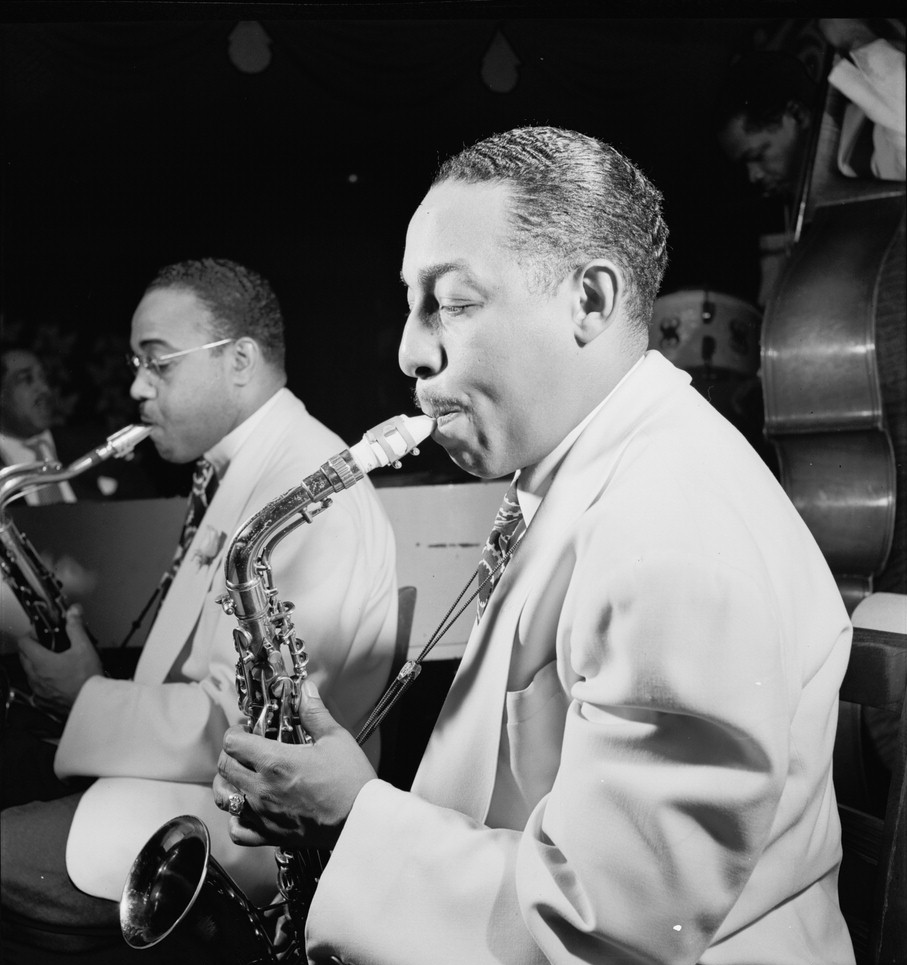
Johnny Hodges, a titan of the alto saxophone, is synonymous with the lush, sophisticated sound of Duke Ellington's Orchestra. For over four decades (1939-1951 and 1955-1970), Hodges was the orchestra's lead alto voice, his playing characterized by a creamy tone, impeccable phrasing, and an uncanny ability to convey deep emotion, from tender balladry to searing blues.
Beyond his pivotal role in the Ellington ensemble, Hodges also led his own recording groups, releasing a string of albums for labels like Verve Records and EmArcy Records that showcased his individual artistry. His signature vibrato and melodic inventiveness made him a highly sought-after sideman and soloist, influencing generations of saxophonists, including John Coltrane and Charlie Parker.
Hodges’s legacy is cemented not just by his prolific output with Ellington, but by his enduring impact on the vocabulary of jazz saxophone. His solos, often concise and perfectly formed, remain benchmarks of melodic construction and emotional depth, proving that power in jazz doesn't always need to be loud, but can be profoundly felt.
Early Life & Influences
Born John Cornelius Hodges in Cambridge, Massachusetts, in 1907, Johnny Hodges initially studied piano and drums before picking up the alto saxophone in his early teens. His early exposure to jazz was through the vibrant Boston music scene, where he encountered pioneers like Sidney Bechet, whose soprano saxophone playing would later be cited by Hodges as an early inspiration. He also absorbed the sounds of Louis Armstrong, particularly Armstrong's melodic phrasing and emotional directness, which left a significant mark on Hodges's own improvisational approach.
Career & Discography
Hodges's professional career began in the late 1920s with various New England bands before he made the pivotal move to New York City in 1938. It was there that he joined Duke Ellington's orchestra, a tenure that would define much of his career. With Ellington, Hodges became the principal alto saxophonist, his solos on tracks like "Jeep's Blues" (1938) and "Mood Indigo" (1930, though his iconic solo came later) becoming legendary. His distinctive sound, often described as "creamy" or "buttery," was instantly recognizable. He also led his own small groups, recording prolifically for labels such as RCA Victor, Verve, and Gotham Records during breaks from Ellington's demanding schedule. After a brief departure in 1951 to lead his own band, he returned to Ellington in 1955, remaining until his death in 1970.
Legacy & Influence
Johnny Hodges's influence on the saxophone is immeasurable. His lyrical style, fluid technique, and masterful use of vibrato set a standard for alto saxophonists that continues to resonate. Players like Phil Woods, Cannonball Adderley, and even Wayne Shorter have acknowledged his profound impact. Hodges demonstrated that a saxophone solo could be as vocally expressive and emotionally resonant as any singer, a skill he honed through his extensive work on ballads. His ability to craft perfectly sculpted solos, often brief yet devastatingly effective, made him a master of musical storytelling.
Cultural Impact
Culturally, Hodges was a cornerstone of the Swing Era and subsequent developments in big band jazz. His long association with Duke Ellington placed him at the center of one of the most important musical institutions in American history. While Ellington's orchestra was a melting pot of diverse talents, Hodges's consistent brilliance provided a vital thread of continuity and sophistication. His solos often served as the emotional core of Ellington's compositions, making them accessible and deeply moving for a wide audience, solidifying jazz's place as a vital American art form.
Key Facts
- Year
- 1907-1970
- Origin
- Cambridge, Massachusetts
- Category
- music
- Type
- artist
Frequently Asked Questions
What is Johnny Hodges most famous for?
Johnny Hodges is most famous for his long tenure as the lead alto saxophonist and a primary soloist with the Duke Ellington Orchestra. His distinctive, lyrical, and blues-inflected saxophone sound became a signature element of Ellington's music, making him one of the most recognizable voices in jazz.
When did Johnny Hodges play with Duke Ellington?
Johnny Hodges first joined the Duke Ellington Orchestra in 1928 and remained with them for most of his career, with a brief hiatus in the mid-1950s. He rejoined in 1955 and stayed until his death in 1970, making his association with Ellington one of the longest and most fruitful in jazz history.
What is Johnny Hodges' signature saxophone sound?
Hodges' signature sound is characterized by its incredibly smooth, rich tone, often described as 'singing.' He employed a distinctive, expressive vibrato and a melodic improvisational style that prioritized emotional depth and lyrical phrasing over technical flash. His blues sensibility was also a key component.
Who did Johnny Hodges influence?
Johnny Hodges influenced a vast number of alto saxophonists and jazz musicians across generations. Figures like Charlie Parker, Sonny Stitt, and Cannonball Adderley have cited his melodic approach and tone as significant inspirations. His influence extends to players who value lyricism and emotional expression in their improvisations.
What are some essential Johnny Hodges recordings?
Essential recordings include his solos on Duke Ellington's "Jeep's Blues" and "Day Dream." As a leader, albums like Ellingtonia: The Big Band Era (1950), Creamy (1956), and Johnny Hodges with Billy Strayhorn (1959) are highly recommended for experiencing his diverse talents.