
Contents
Overview
The story of millisecond pulsars begins not with their discovery, but with the theoretical prediction of neutron stars themselves, first proposed by Lev Landau in 1932 and later solidified by the work of J. Robert Oppenheimer and George Gamow in the late 1930s. The first pulsar, a rapidly rotating neutron star emitting radio pulses, was discovered serendipitously by Jocelyn Bell Burnell and Antony Hewish in 1967, an event that earned Hewish the Nobel Prize in Physics in 1974. However, it wasn't until 1982 that the first true millisecond pulsar, PSR B1937+21, was discovered by Don Backer and colleagues. This discovery was revolutionary, as its rotation period of just 1.5 milliseconds was far faster than any previously known pulsar, immediately suggesting a different evolutionary path, likely involving accretion from a binary companion, a process later termed 'recycling.' This marked a significant departure from the 'young and energetic' pulsars initially envisioned.
⚙️ How It Works
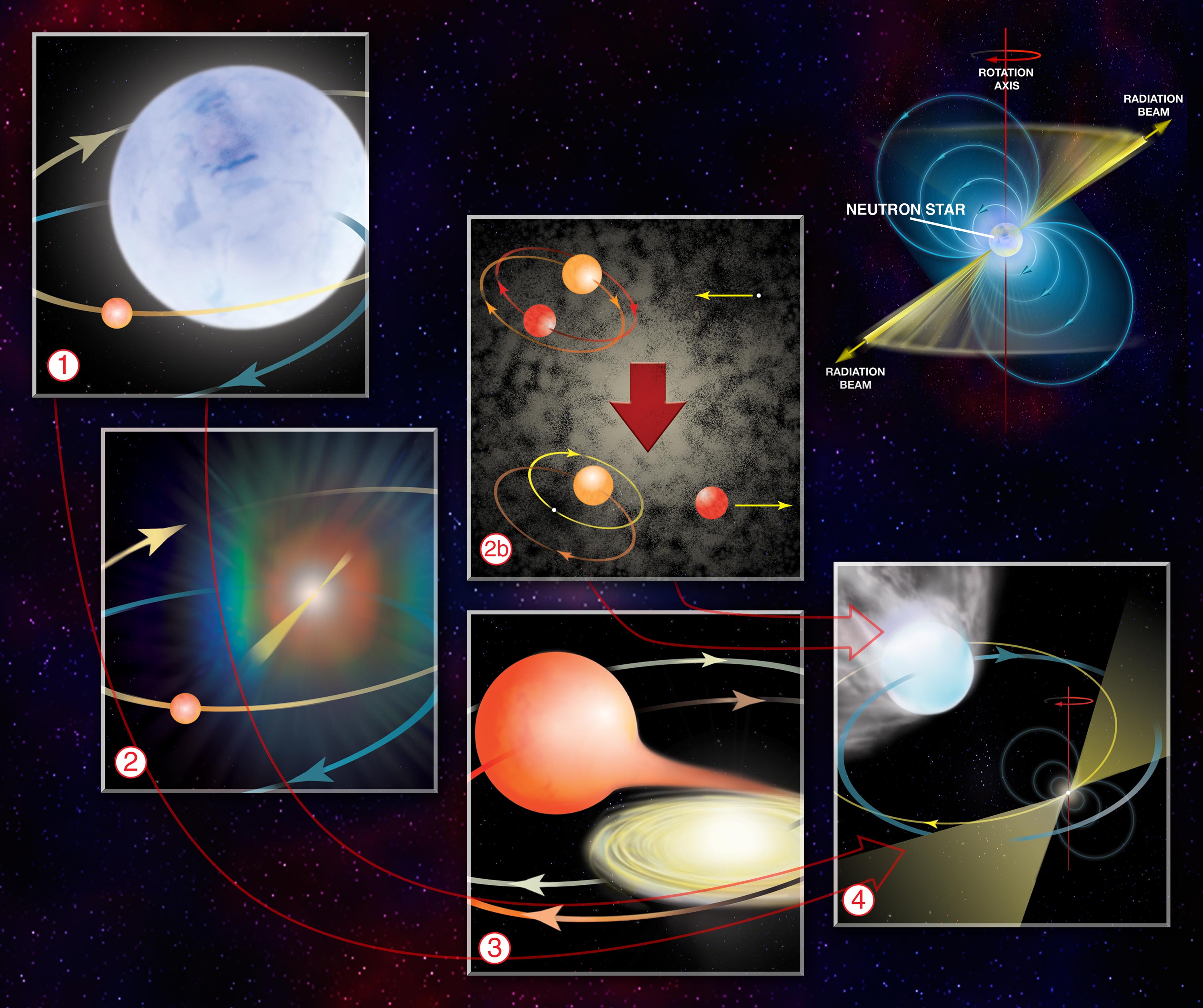
Millisecond pulsars are born from the explosive death of massive stars, collapsing into incredibly dense neutron stars. The key to their millisecond rotation lies in a process of 'recycling' within binary systems. As a neutron star orbits a companion star, it can accrete matter from its partner. This infalling material carries angular momentum, effectively spinning the neutron star up to incredible speeds over millions of years. The companion star can be a main-sequence star, a white dwarf, or even another neutron star. In some cases, the companion is completely consumed, leaving behind a solitary, rapidly spinning MSP. The intense magnetic fields of these neutron stars, coupled with their rapid rotation, generate powerful beams of electromagnetic radiation that sweep across space like a lighthouse. When these beams align with Earth, we detect them as regular pulses, hence the term 'pulsar.' The exact mechanisms of spin-up and the fate of the companion star are areas of active research, with models involving Type Ia supernovae and X-ray binaries playing crucial roles.
📊 Key Facts & Numbers
The rotational periods of millisecond pulsars are astonishingly short, with the fastest known, PSR J1748-2446ad, spinning at an incredible 716 times per second, corresponding to a period of just 1.39 milliseconds. A typical MSP has a mass of about 1.4 times that of our Sun, compressed into a sphere only about 20 kilometers (12 miles) in diameter, resulting in densities trillions of times greater than water. The surface gravity is estimated to be around 2 x 10^11 m/s², or 20 billion times that of Earth. The magnetic fields of MSPs are generally weaker than those of younger pulsars, typically ranging from 10^8 to 10^10 Gauss, compared to the 10^12 to 10^15 Gauss found in young pulsars. However, some MSPs are found in binary systems with white dwarfs, where the orbital periods can be as short as a few hours, and the orbital velocities can reach hundreds of kilometers per second, providing precise measurements of their masses and spins.
👥 Key People & Organizations
Pioneering work in pulsar astronomy, including the discovery of MSPs, involved researchers like Don Backer, who led the team that discovered the first MSP, PSR B1937+21, in 1982. Alex Filippenko, a prominent observational astronomer, has made significant contributions to understanding the evolution of stellar remnants, including pulsars and white dwarfs. The Parkes Observatory in Australia and the Green Bank Telescope in West Virginia have been instrumental facilities for pulsar detection and timing. The North American Nanohertz Gravitational Wave Observatory (NANOGrav) collaboration, a consortium of scientists using pulsar timing arrays, is a leading effort in the search for gravitational waves, with MSPs forming the backbone of their detectors. Key theoretical physicists like Frederic K. K. Chattopadhyay have also contributed to understanding the extreme physics of neutron stars.
🌍 Cultural Impact & Influence
The discovery of millisecond pulsars has profoundly impacted our understanding of astrophysics and fundamental physics. They serve as crucial laboratories for testing Einstein's theory of General Relativity with unprecedented precision, particularly through the precise timing of pulsars in binary systems, such as the Hulse-Taylor binary pulsar (though not an MSP, it paved the way). MSPs are also key targets in the search for gravitational waves, with their precise timing allowing scientists to detect subtle distortions in spacetime caused by massive cosmic events. Furthermore, their extreme densities and magnetic fields provide insights into the behavior of matter under conditions impossible to replicate on Earth, informing nuclear physics and the equation of state for neutron stars. The study of MSPs has also influenced science fiction, with their mind-boggling properties inspiring narratives about cosmic phenomena and advanced civilizations.
⚡ Current State & Latest Developments
Current research on millisecond pulsars is focused on several key areas. The Parkes Pulsar Timing Array (PPTA), the NANOGrav collaboration, and the European Pulsar Timing Array (EPTA) are actively searching for the stochastic background of gravitational waves predicted by cosmic inflation and supermassive black hole mergers. Recent results from these collaborations indicate strong evidence for such a background, likely originating from the inspiral of supermassive black hole binaries across the universe. Astronomers are also using instruments like the Chandra X-ray Observatory and the Hubble Space Telescope to study MSPs in X-ray binaries, seeking to understand the accretion processes that spin them up and the nature of their companion stars. The Square Kilometre Array (SKA) project, currently under construction, promises to revolutionize pulsar astronomy with its unparalleled sensitivity, enabling the discovery of thousands of new MSPs and providing much more precise timing data.
🤔 Controversies & Debates
One of the primary debates surrounding millisecond pulsars concerns their precise formation channels and the exact nature of their companion stars. While the 'recycling' hypothesis is widely accepted, the specifics of how matter is transferred and how the companion star evolves or is destroyed remain subjects of investigation. For instance, the role of common envelope evolution in binary systems is crucial but complex to model accurately. Another area of discussion is the origin of the observed distribution of MSP spin periods and magnetic field strengths; why are some recycled pulsars found with relatively strong magnetic fields, and what determines the final spin period? Furthermore, the interpretation of the recent gravitational wave background signals detected by pulsar timing arrays is still being refined, with ongoing efforts to distinguish between different astrophysical sources and to rule out instrumental or interstellar medium effects.
🔮 Future Outlook & Predictions
The future of millisecond pulsar research is exceptionally bright, driven by advancements in observational technology and theoretical modeling. The full commissioning of the Square Kilometre Array (SKA) is expected to discover thousands of new MSPs, significantly expanding the sample size for timing arrays and allowing for more robust detection and characterization of gravitational waves. This will enable scientists to probe the universe at lower frequencies and potentially detect gravitational waves from earlier cosmic epochs. Future observations will also aim to precisely measure the masses of MSPs, pushing the boundaries of our understanding of the equation of state of nuclear matter and potentially revealing the existence of exotic states like [[quark-gluon-pl
Key Facts
- Category
- science
- Type
- topic