
Contents
Overview
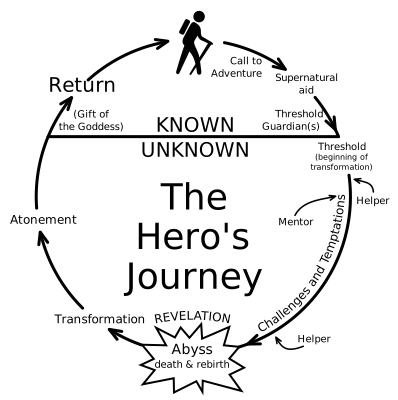
The monomyth, famously articulated by Joseph Campbell as the 'hero's journey,' is a fundamental narrative archetype found across global cultures and throughout history. It describes a cyclical pattern where a protagonist departs from their ordinary world, faces trials and tribulations in an extraordinary realm, achieves a decisive victory, and returns transformed, bringing newfound wisdom or boons to their community. Campbell, influenced by Carl Jung's theories on the collective unconscious, identified this pattern in ancient myths, religious texts, and folklore, suggesting a shared psychological foundation for human storytelling. While Campbell's 1949 book The Hero with a Thousand Faces popularized the concept, its influence extends far beyond academic circles, shaping countless modern films, books, and video games, from Star Wars to The Matrix. The enduring power of the monomyth lies in its ability to resonate with universal human experiences of growth, challenge, and transformation.
🎵 Origins & History
The concept of a universal narrative pattern has roots stretching back to early 20th-century anthropological and psychological inquiries. Scholars like Otto Rank and Lord Raglan had previously explored recurring motifs in hero myths. Joseph Campbell synthesized these ideas into a cohesive framework. Deeply influenced by Carl Jung's work on archetypes and the collective unconscious, Campbell meticulously analyzed myths from diverse cultures, including those of ancient Egypt, Greece, India, and indigenous American traditions. His seminal 1949 book, The Hero with a Thousand Faces, presented the monomyth as a cyclical journey comprising distinct stages, arguing that these narratives reflect fundamental human psychological processes and spiritual quests. Campbell's work provided a powerful lens for understanding the underlying unity in seemingly disparate mythological traditions.
⚙️ How It Works
The monomyth, as detailed by Joseph Campbell, typically unfolds in three primary acts: Departure, Initiation, and Return. The Departure begins with the hero's call to adventure and their crossing of the threshold from the ordinary world into a special, often supernatural, realm. During the Initiation phase, the hero confronts trials, allies, and enemies, undergoing a central ordeal or 'death and rebirth' that leads to a significant boon or revelation. The final act, the Return, sees the hero re-enter the ordinary world, transformed by their experiences and equipped to share their newfound wisdom or power, often facing challenges in integrating their extraordinary journey with their everyday life. This cyclical structure, with its emphasis on transformation through ordeal, forms the backbone of countless heroic narratives.
📊 Key Facts & Numbers
The monomyth's influence is quantifiable in its pervasive presence across media. It's estimated that over 70% of major Hollywood films released between 2000 and 2010 followed a structure closely aligned with Campbell's hero's journey. The Star Wars franchise, particularly the original trilogy, is often cited as a near-perfect embodiment, grossing over $1.8 billion worldwide by 1983 for the first three films alone. J.R.R. Tolkien's The Lord of the Rings trilogy, published between 1954 and 1955, also demonstrates the monomyth's power, selling over 150 million copies globally. The concept has been applied to analyze everything from ancient epics like The Odyssey to modern video games, with titles like The Legend of Zelda series consistently employing its narrative beats.
👥 Key People & Organizations
Joseph Campbell (1904-1987) is the central figure who popularized the monomyth. His work built upon the psychological theories of Carl Jung (1875-1961) and the earlier mythological analyses of Otto Rank (1884-1939) and Lord Raglan (1885-1967). In the realm of filmmaking, George Lucas explicitly acknowledged Campbell's influence on Star Wars. Academics continue to explore and debate the monomyth, with scholars like Christopher Vogler, a former Disney executive, adapting Campbell's ideas into practical screenwriting guides, and figures like Robert Moore and Douglas Gillette further developing Jungian archetypes in relation to the masculine psyche.
🌍 Cultural Impact & Influence
The monomyth's impact on global culture is profound, serving as a foundational blueprint for storytelling across diverse media. The hero's journey is a staple in literature, video games like Final Fantasy, and even marketing campaigns that frame brands as guides on a consumer's transformative path. The archetype's resonance lies in its ability to tap into universal human desires for growth, meaning, and overcoming adversity, making stories structured around it inherently compelling and relatable to audiences worldwide. Its influence has also permeated self-help and personal development fields, offering frameworks for individual growth.
⚡ Current State & Latest Developments
In 2024, the monomyth remains a dominant force in narrative creation, though its application is continuously evolving. While many contemporary creators still adhere to its core principles, there's a growing trend towards subverting or deconstructing the traditional hero's journey. This includes exploring anti-heroes, questioning the 'boon' brought back, or focusing on communal rather than individual heroism. Platforms like Netflix and Disney+ continue to produce content heavily influenced by the monomyth, while independent creators and international cinema often experiment with its variations. The rise of interactive storytelling in video games and virtual reality also presents new avenues for exploring the hero's journey, allowing players to embody the protagonist and experience the transformation firsthand. The ongoing adaptation of the monomyth reflects its enduring flexibility and relevance.
🤔 Controversies & Debates
The primary controversy surrounding the monomyth centers on its universality and potential for cultural bias. Critics argue that Joseph Campbell's framework, while drawing from global myths, is heavily weighted towards patriarchal and Western interpretations, potentially overlooking or misrepresenting narratives from non-Western or matriarchal cultures. Some scholars contend that the 'hero' archetype itself is problematic, promoting individualism over community and perpetuating a cycle of violence. The rigid application of the monomyth in Hollywood has been criticized for leading to formulaic storytelling, stifling originality and diversity in narrative structures. The debate questions whether the monomyth is a true universal pattern or a culturally specific construct that has been overgeneralized.
🔮 Future Outlook & Predictions
The future of the monomyth likely involves continued adaptation and subversion. As global storytelling becomes more interconnected, we can expect a greater blending of narrative traditions, potentially leading to new archetypal patterns that incorporate diverse cultural perspectives more authentically. The rise of AI-generated narratives might also offer novel interpretations or even challenge the very notion of a singular monomyth. While the classic hero's journey will undoubtedly persist, future iterations may prioritize collaborative journeys, focus on the 'return' phase's challenges, or explore the experiences of supporting characters. The monomyth's enduring appeal suggests it will continue to be a vital, albeit evolving, framework for understanding human stories.
💡 Practical Applications
The monomyth's structure offers a powerful toolkit for creators across various fields. In filmmaking and literature, it provides a reliable narrative arc for developing compelling characters and engaging plots, as seen in the success of The Hunger Games series. For game developers, the hero's journey is a natural fit for crafting immersive player experiences, guiding players through challenges and character progression, a strategy employed by Nintendo in titles like The Legend of Zelda. In personal development and coaching, the stages of the monomyth are used metaphorically to help individuals understand and navigate their own life challenges, personal growth, and transitions, often drawing parallels to figures like Bruce Wayne's transformation into Batman.
Key Facts
- Category
- culture
- Type
- topic