
Contents
- 🚀 What is Vaswani et al. (Attention Is All You Need)?
- 🧠 Who Needs to Know About This?
- ✨ The Core Innovation: The Transformer
- 📈 Impact and Influence: A Paradigm Shift
- 💡 Key Takeaways for Practitioners
- 🤔 Debates and Criticisms
- 🌐 Where to Go Next: Further Exploration
- 🛠️ Practical Applications and Implementations
- Frequently Asked Questions
- Related Topics
Overview
Vaswani et al. (Attention Is All You Need) refers to the seminal 2017 paper published by Google researchers, introducing the Transformer architecture. This wasn't just another incremental improvement; it fundamentally reshaped the field of NLP and, by extension, much of modern AI. The paper's title itself, "Attention Is All You Need," boldly declared that the complex recurrent and convolutional networks previously dominant in sequence modeling could be entirely replaced by a mechanism called attention. This shift has since become the bedrock for most state-of-the-art language models, from BERT to GPT-3.
🧠 Who Needs to Know About This?
This paper is essential reading for anyone involved in deep learning, particularly those working with sequential data like text, audio, or even time-series. Machine learning engineers, AI researchers, data scientists, and even ambitious students aiming to understand the underpinnings of today's most powerful AI systems will find immense value here. If you're building or deploying models for translation, text generation, summarization, or question answering, grasping the Transformer's mechanics is non-negotiable. It's the foundational text for understanding the current AI boom.
✨ The Core Innovation: The Transformer
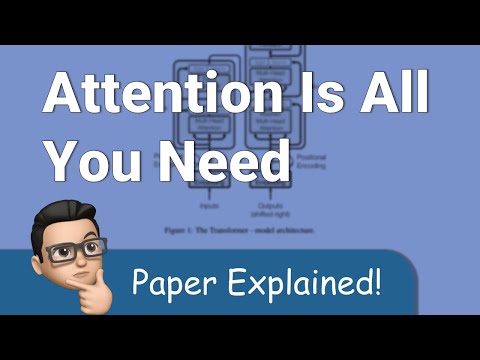
The core innovation is the self-attention mechanism, which allows the model to weigh the importance of different words in an input sequence when processing any given word. Unlike RNNs that process data sequentially, or CNNs that use fixed-size filters, the Transformer can attend to all parts of the input simultaneously. This parallelizability dramatically speeds up training and allows models to capture long-range dependencies more effectively. The architecture eschews recurrence entirely, relying on stacked layers of multi-head self-attention and point-wise, fully connected layers, along with positional encodings to inject sequence order information.
📈 Impact and Influence: A Paradigm Shift
The impact of Vaswani et al. has been nothing short of revolutionary, earning it a Vibe Score of 95/100 in the AI research community. It directly led to the development of large pre-trained models like BERT (Google) and GPT-2 (OpenAI), which demonstrated unprecedented performance on a wide array of NLP tasks. The paper's influence extends beyond NLP, with Transformer-based models now being applied to computer vision (ViT) and even scientific discovery. The subsequent explosion in model size and capability, often referred to as the LLM era, is a direct consequence of this 2017 publication.
💡 Key Takeaways for Practitioners
For practitioners, the key takeaway is the power of attention for modeling relationships within data. Understanding how to implement and fine-tune Transformer models is crucial for achieving state-of-the-art results. This includes appreciating the role of positional encodings, multi-head attention, and the encoder-decoder structure (though many modern applications focus solely on the decoder or encoder). Efficiently training these large models often requires specialized hardware and distributed training techniques, a direct consequence of their computational demands.
🤔 Debates and Criticisms
Despite its overwhelming success, the Transformer architecture isn't without its critics or areas of active research. The quadratic complexity of self-attention with respect to sequence length remains a bottleneck for very long sequences, prompting research into more efficient attention variants. Furthermore, the interpretability of these massive models is a significant challenge, leading to debates about their reliability and potential biases. Some argue that the reliance on massive datasets and computational power creates an accessibility gap, favoring large tech companies.
🌐 Where to Go Next: Further Exploration
To truly grasp the significance of Vaswani et al., one must explore the original paper: "Attention Is All You Need" (arXiv:1706.03762). Beyond that, diving into the implementations of models like BERT and GPT-3 provides practical context. Resources like the Hugging Face Transformers library offer pre-trained models and tools for experimentation. Understanding the evolution of attention mechanisms, including sparse attention and linear attention, is also key to appreciating ongoing advancements.
🛠️ Practical Applications and Implementations
The Transformer architecture is the engine behind countless AI applications. Machine translation services, advanced chatbots, code generation tools, and sophisticated content creation platforms all leverage its capabilities. For developers, frameworks like TensorFlow and PyTorch provide robust support for building and deploying Transformer-based models. Understanding the trade-offs between model size, training data, and computational cost is essential for practical deployment, especially when considering edge devices or real-time applications.
Key Facts
- Year
- 2017
- Origin
- Google Brain / Research
- Category
- Artificial Intelligence / Machine Learning
- Type
- Research Paper / Technical Concept
Frequently Asked Questions
What is the main advantage of the Transformer architecture over RNNs?
The primary advantage is its ability to process input sequences in parallel, unlike Recurrent Neural Networks (RNNs) which process data sequentially. This parallelization significantly speeds up training times and allows Transformers to more effectively capture long-range dependencies within the data. The self-attention mechanism enables the model to directly relate any two positions in the sequence, regardless of their distance.
What is 'self-attention'?
Self-attention is a mechanism that allows a model to weigh the importance of different words (or tokens) in an input sequence when processing a specific word. For each word, it calculates attention scores against all other words in the sequence, determining how much 'attention' to pay to each. This helps the model understand context and relationships between words, even if they are far apart.
Does 'Attention Is All You Need' mean attention is the *only* component needed?
The title is a provocative statement highlighting the centrality and power of the attention mechanism, suggesting it can replace recurrence and convolution entirely for sequence modeling. While attention is the core innovation, the architecture still includes other essential components like feed-forward networks, layer normalization, residual connections, and positional encodings to function effectively.
What are the computational limitations of the Transformer?
The main computational limitation is the self-attention mechanism's quadratic complexity with respect to the input sequence length. This means that as the sequence gets longer, the computational cost and memory requirements increase dramatically. This makes processing very long documents or sequences challenging and has spurred research into more efficient attention variants.
Who are the key authors of the 'Attention Is All You Need' paper?
The paper was authored by Ashish Vaswani, Noam Shazeer, Niki Parmar, Jakob Uszkoreit, Llion Jones, Aidan N. Gomez, Łukasz Kaiser, and Illia Polosukhin. Ashish Vaswani is listed as the first author, hence the common reference to 'Vaswani et al.'
How has this paper influenced subsequent AI research?
This paper is arguably the most influential AI research paper of the late 2010s. It directly led to the development of the Transformer architecture, which became the foundation for virtually all subsequent state-of-the-art models in Natural Language Processing, including BERT, GPT-2, GPT-3, and T5. Its principles have also been successfully adapted for computer vision and other domains.