
Contents
Overview
AM radio, with a vibe rating of 6, has been a staple of broadcasting since the early 20th century, with the first commercial station, KDKA, launching in 1920. This medium has been a key player in shaping the music industry, with stations like WABC and KHJ dominating the airwaves in the 1960s and 1970s. However, with the rise of FM radio and digital streaming, AM radio's influence has waned, and its future is uncertain. Despite this, AM radio still maintains a loyal following, with many stations continuing to broadcast news, talk shows, and sports. The controversy surrounding AM radio's decline has sparked debates about the role of traditional media in the digital age. As of 2022, there are over 4,700 AM radio stations in the United States alone, with notable stations like WCBS and WGN still going strong.
📻 Introduction to AM Radio
📻 Introduction to AM Radio: AM radio is a type of radio broadcasting that uses amplitude modulation (AM) transmissions to transmit audio signals. It was the first method developed for making audio radio transmissions and is still used worldwide, primarily for medium wave transmissions, but also on the longwave and shortwave radio bands. AM radio is a popular choice for news, talk shows, and sports broadcasts, and is often used by amateur radio operators and emergency services. For more information on radio broadcasting, visit the Radio Broadcasting page. AM radio has a rich history, dating back to the early 20th century, and has played a significant role in shaping the media landscape.
🔍 History of AM Broadcasting
🔍 History of AM Broadcasting: The history of AM broadcasting dates back to the early 20th century, when Guglielmo Marconi and Lee de Forest developed the first AM radio transmitters. The first commercial AM radio station, KDKA, was launched in 1920 in Pittsburgh, Pennsylvania, and was a huge success. AM radio quickly became popular, and by the 1930s, it was the dominant form of radio broadcasting. For more information on the history of radio, visit the History of Radio page. The development of AM radio was influenced by the work of Nikola Tesla and Heinrich Hertz, who made significant contributions to the field of electromagnetism.
📡 How AM Radio Works
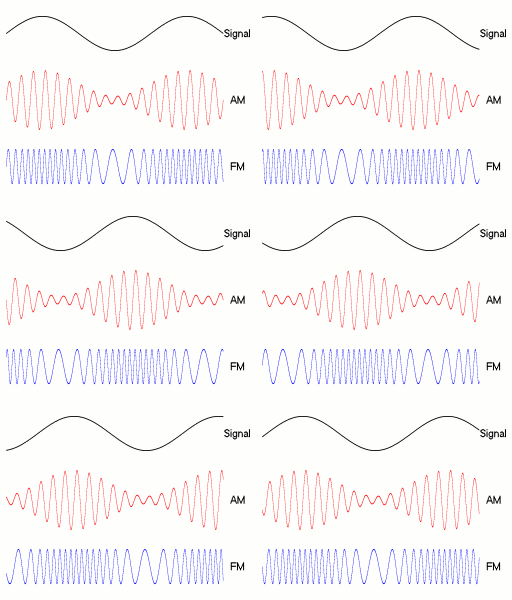
📡 How AM Radio Works: AM radio works by modulating the amplitude of a carrier wave with an audio signal. The carrier wave is transmitted at a specific frequency, and the audio signal is encoded onto the carrier wave using amplitude modulation. The resulting signal is then transmitted over the airwaves, where it can be received by an AM radio receiver. For more information on how radio signals work, visit the Radio Signals page. AM radio receivers use a tuner to select the desired frequency and a detector to extract the audio signal from the carrier wave. The audio signal is then amplified and played through a speaker.
🌎 Global AM Radio Usage
🌎 Global AM Radio Usage: AM radio is used worldwide, with thousands of stations broadcasting on the medium wave, longwave, and shortwave bands. In the United States, AM radio is regulated by the Federal Communications Commission (FCC), which assigns frequencies and licenses to stations. For more information on radio regulation, visit the Radio Regulation page. AM radio is also used in many other countries, including Canada, Mexico, and Australia. The global usage of AM radio is influenced by the work of international organizations such as the International Telecommunication Union (ITU).
📊 Comparison with FM Radio
📊 Comparison with FM Radio: AM radio is often compared to FM radio, which uses frequency modulation (FM) to transmit audio signals. FM radio has several advantages over AM radio, including better sound quality and less interference. However, AM radio has a longer range and can be received by simpler, less expensive receivers. For more information on FM radio, visit the FM Radio page. The choice between AM and FM radio depends on the specific application and the desired level of sound quality. AM radio is often used for talk shows and news broadcasts, while FM radio is often used for music and other audio programs.
👥 Target Audience
👥 Target Audience: AM radio is targeted towards a wide range of audiences, including news junkies, sports fans, and music lovers. AM radio is also popular among commuters and travelers, who can listen to AM radio stations while on the go. For more information on radio audiences, visit the Radio Audiences page. AM radio stations often cater to specific demographics, such as young adults or seniors. The target audience for AM radio is influenced by the type of content being broadcast and the desired level of engagement.
💰 Pricing and Plans
💰 Pricing and Plans: The cost of listening to AM radio is typically free, as most AM radio stations broadcast their signals over the airwaves. However, some AM radio stations may offer premium content or services, such as podcasts or online streaming, for a fee. For more information on radio pricing, visit the Radio Pricing page. The cost of operating an AM radio station can be significant, and stations often rely on advertising revenue to stay on the air. The pricing and plans for AM radio are influenced by the type of content being broadcast and the desired level of revenue.
📈 Future of AM Radio
📈 Future of AM Radio: The future of AM radio is uncertain, as many listeners are switching to digital radio and online streaming services. However, AM radio still has a loyal following, and many stations are adapting to the changing media landscape by offering online streaming and social media services. For more information on the future of radio, visit the Future of Radio page. The future of AM radio is influenced by the development of new technologies, such as 5G and artificial intelligence.
🤔 Controversies and Challenges
🤔 Controversies and Challenges: AM radio has faced several controversies and challenges over the years, including interference from other radio signals and pirate radio stations. AM radio has also been criticized for its sound quality, which can be affected by atmospheric conditions and electromagnetic interference. For more information on radio controversies, visit the Radio Controversies page. The controversies and challenges facing AM radio are influenced by the type of content being broadcast and the desired level of engagement.
📚 Resources and References
📚 Resources and References: For more information on AM radio, visit the AM Radio page. Additional resources include the Radio Broadcasting page and the History of Radio page. AM radio is also discussed in the context of media landscape and electromagnetism.
Key Facts
- Year
- 1920
- Origin
- United States
- Category
- Technology
- Type
- Technology
Frequently Asked Questions
What is AM radio?
AM radio is a type of radio broadcasting that uses amplitude modulation (AM) transmissions to transmit audio signals. It was the first method developed for making audio radio transmissions and is still used worldwide, primarily for medium wave transmissions, but also on the longwave and shortwave radio bands. For more information, visit the AM Radio page.
How does AM radio work?
AM radio works by modulating the amplitude of a carrier wave with an audio signal. The carrier wave is transmitted at a specific frequency, and the audio signal is encoded onto the carrier wave using amplitude modulation. The resulting signal is then transmitted over the airwaves, where it can be received by an AM radio receiver. For more information, visit the Radio Signals page.
What are the advantages of AM radio?
AM radio has several advantages, including its long range and ability to be received by simple, inexpensive receivers. AM radio is also often used for talk shows and news broadcasts, and is popular among commuters and travelers. For more information, visit the AM Radio page.
What are the disadvantages of AM radio?
AM radio has several disadvantages, including its sound quality, which can be affected by atmospheric conditions and electromagnetic interference. AM radio is also often criticized for its lack of frequency response and dynamic range. For more information, visit the Radio Controversies page.
Is AM radio still relevant?
Yes, AM radio is still relevant, despite the rise of digital radio and online streaming services. Many listeners still prefer the simplicity and familiarity of AM radio, and many stations are adapting to the changing media landscape by offering online streaming and social media services. For more information, visit the Future of Radio page.
How can I listen to AM radio?
You can listen to AM radio by tuning into a local AM radio station using an AM radio receiver. Many AM radio stations also offer online streaming services, which can be accessed through their websites or mobile apps. For more information, visit the Radio Pricing page.
Can I use AM radio for emergency communications?
Yes, AM radio can be used for emergency communications, such as during natural disasters or power outages. Many emergency services, such as police and fire departments, use AM radio to communicate with the public and coordinate response efforts. For more information, visit the Emergency Services page.